Burnsville Wood Flooring has been doing wood flooring in Bloomington for more than twenty years, and a good share of that work arrives with a date already attached to it. The house is going on the market, the photographer is booked, and the floors have to be finished before either happens.
That deadline is not a preference, it is a scheduling problem with a fixed end, and the sequence has to be built backward from it. Sellers here also have a filing to make before the listing goes live, which puts two hard points on the calendar rather than one. We plan against both of them out loud.
None of that changes if you are staying put. Most of what follows applies just as well to an owner with no intention of selling. The only difference is who sets the clock.
The report that has to be on file before the sign goes up
The City of Bloomington runs a Time-of-Sale housing inspection program, and it reaches further than most sellers expect. Single and two-family dwellings, condominiums, townhouses and mobile homes offered for sale all fall inside it. The report has to be filed with the City before the home is listed, and a copy of the original evaluation report has to be submitted within seven calendar days after the evaluation.
Those are two clocks running in opposite directions. The seven calendar days sit behind the evaluation, and the filing sits in front of the listing. Book the evaluation late and the second deadline quietly eats the first.
It is paperwork, not a repair order
The program puts information in front of a buyer on a schedule. It is a disclosure step, and we do not treat it as anything more than that. We say so because sellers sometimes call us convinced that a note about the floors has to be answered inside a few days, and that belief produces bad flooring decisions. The usual one is a fast coat of finish over a floor that needed a full sand.
What the report does accomplish is putting the condition of the floor into a written record a buyer will read. That is reason enough to look at the floors early, without inventing an emergency that is not there.
Why we ask about your dates on the first call
When someone here calls about a refinish, one of the first things we ask is whether the house is going on the market and when. If it is, the estimate changes shape. We stop quoting the best floor available and start quoting the best floor available inside a fixed number of days, and those are not the same quote.
The answer goes in writing either way. A grit sequence and a finish schedule leave with the quote, with the days each stage needs written beside it, so the plan can be checked against a calendar instead of against a promise.
Looking for wood-flooring closer to Eagan? See Wood-Flooring in Eagan.
Reading a time-of-sale evaluation for what it says about the floor
An evaluator is looking at a whole house, not at your floors in particular, and the notes about them tend to be short: worn finish, gaps, a soft spot, loose treads. Short notes are still notes a buyer reads, so it pays to know what each one usually means before deciding what to spend on it.
Gaps in a report written in February
Seasonal gapping between boards is normal in a heated Minnesota house, and a good share of it closes again by June. We measure it and explain it before anyone writes it down as a defect. Wood flooring is specified for a relative humidity band of roughly thirty to fifty percent, and a forced-air house in a Bloomington January routinely drops out the bottom of that band, which pulls moisture out of the boards and opens the joints.
That is why we read indoor relative humidity with a hygrometer on the first visit and write the number down. A floor sitting at a low equilibrium moisture content in midwinter photographs differently than the same floor in July, and knowing which one the evaluator saw changes the recommendation. A whole-house humidifier closes more winter gapping than a sander ever will.
Cupping is a different note entirely
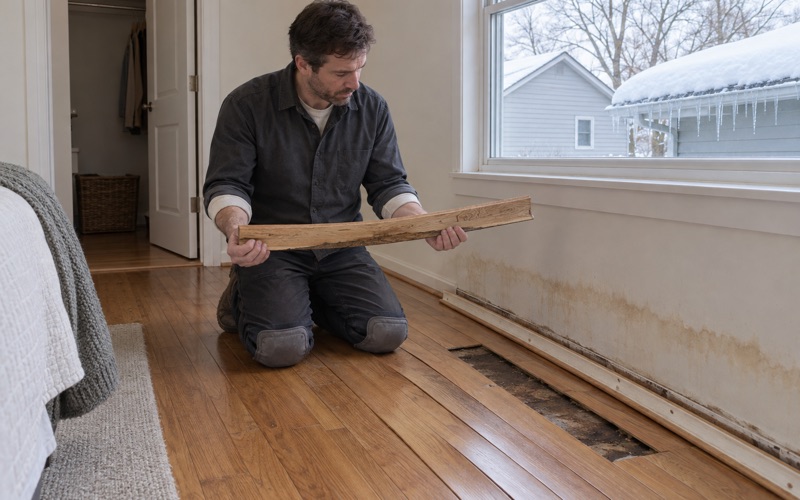
Cupping, where the board edges stand higher than the centers, is a moisture content differential rather than a seasonal swing, and it usually means the underside of the floor is wetter than the top. We check the moisture content of the boards against the moisture content of the plywood or OSB subfloor before recommending anything, because sanding a cupped floor flat while it is still wet produces crowning later, once it finally dries.
Dry cupping, buckling and a floor that was sanded flat in the wrong month can all leave the same three-word note on an evaluation and need completely different answers. A moisture meter settles which one you have in about ten minutes.
Squeaks, treads and the small items
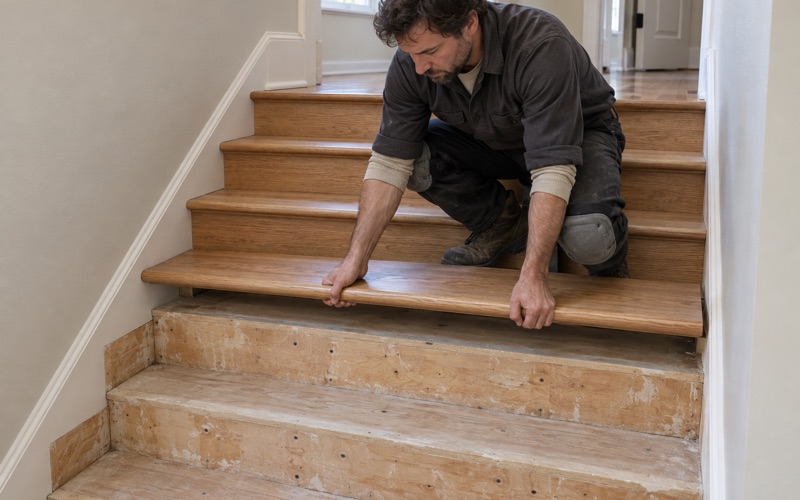
A squeak is almost always a fastener or subfloor question rather than a finish question, and the fix is refastening into joists, not more polyurethane. A cracked nosing, a loose stair tread, a reducer that has lifted at a doorway. These are cheap to correct and they photograph badly, which is a poor combination to leave alone.
When the main floor is already being refinished, stairs are usually the last item decided and the first thing a buyer puts a hand on. We would rather price treads and risers into the original quote than come back for them.
Fitting the work in front of a listing date
What each stage actually costs in days
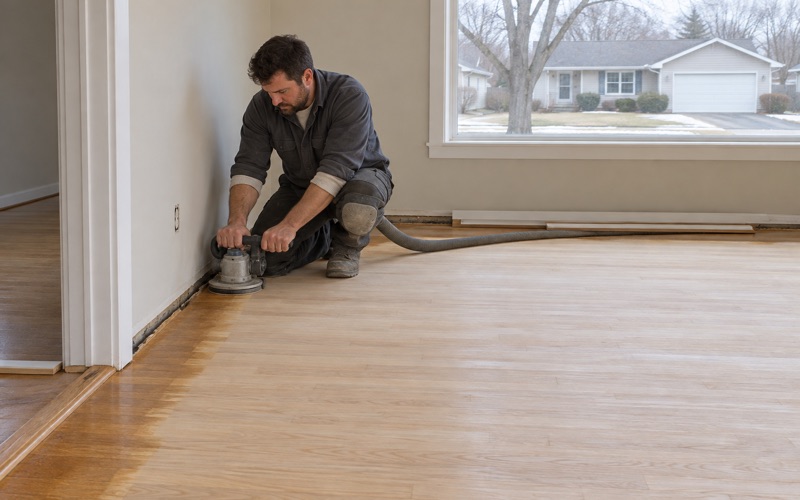
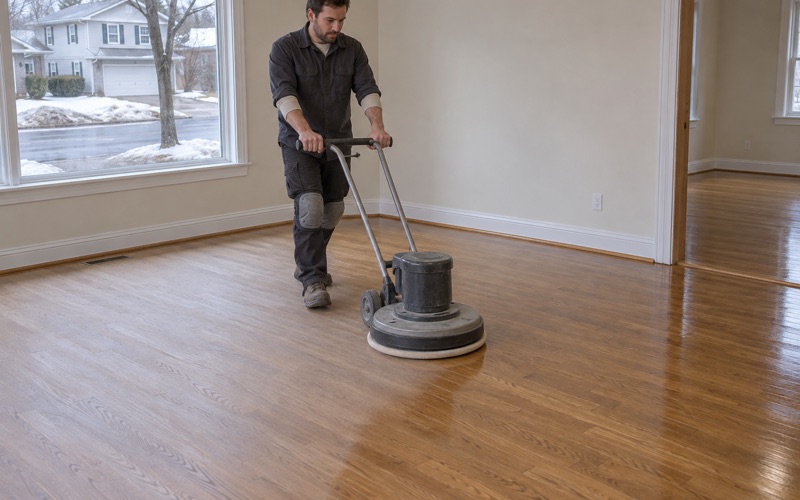
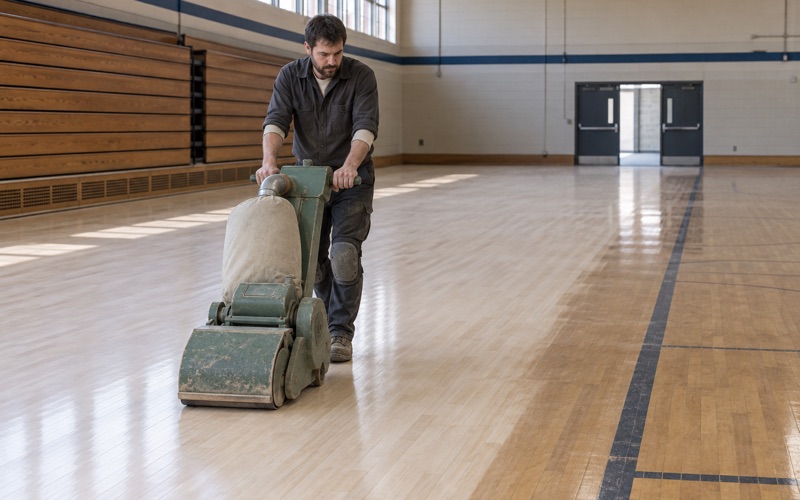
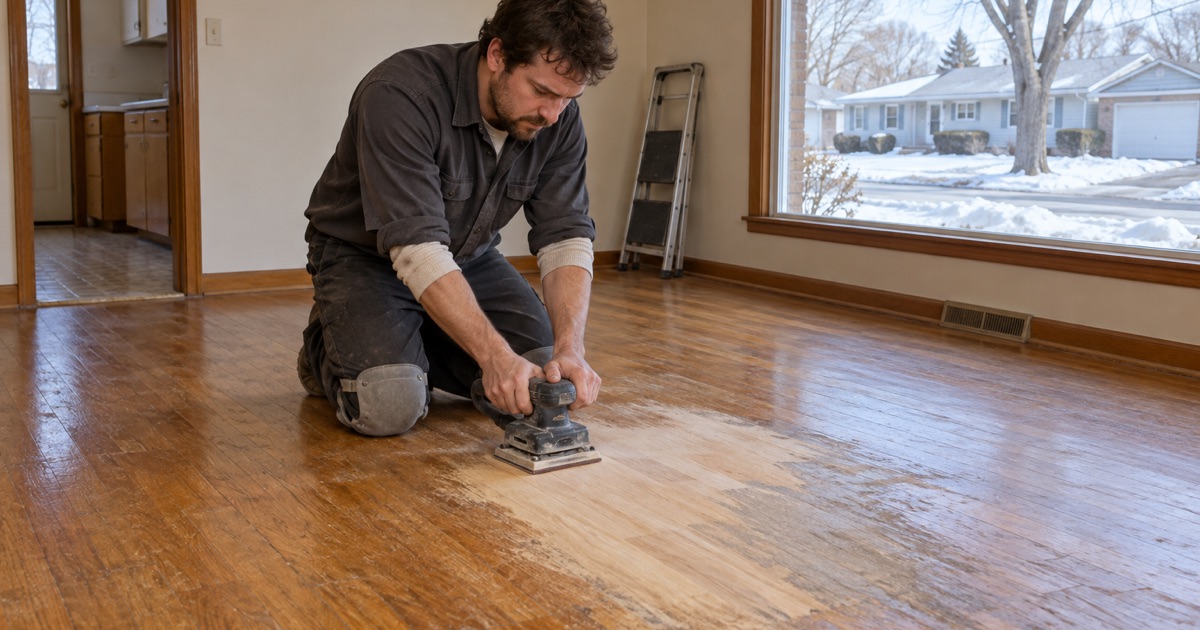
A full sand-and-refinish on a typical main floor runs a written progression, a 36-50-80 grit sequence with the drum sander, an edger into the perimeter and corners, and a buffer to blend the two together before any finish goes on. The sanding is not the part that governs the calendar. The finish is.
Waterborne polyurethane recoats the same day and lets you walk on the floor sooner. Oil-modified polyurethane takes longer between coats and carries an odor through the house for days. Either way, dry time and cure time are separate numbers, and staging a house is a cure-time question.
You can walk on a floor long before you should be sliding a sofa across it or laying an area rug over it. Both numbers go on the schedule so the moving truck is not booked against the wrong one.
When a screen-and-recoat is the right call
If the wear is in the finish rather than down in the wood, an abrasive screen and a fresh coat will get a floor ready for photographs in a fraction of the time and cost of a full refinish. We quote the recoat honestly against the sand, including the times the cheaper one is the correct one, which in front of a listing date it frequently is.
On engineered flooring we measure the wear layer before quoting a refinish at all. Past a certain thinness there is nothing left above the core to sand, and a sand-through on a seller’s floor two weeks before the listing is not a recoverable mistake.
Dust, and a straight answer about it
Every sanding job runs dust containment, and we will tell you plainly what it does not catch. Fine dust still reaches bookshelves and the tops of door casings. In an occupied house that is about to be shown to buyers, that matters, and it is better said before the machines arrive than after they leave.
The crew that walks the house for the estimate is the crew that rolls the last coat. On a job with a listing date behind it, a handoff between crews is where days go missing and nobody can say exactly how.
Working with the heating season instead of against it
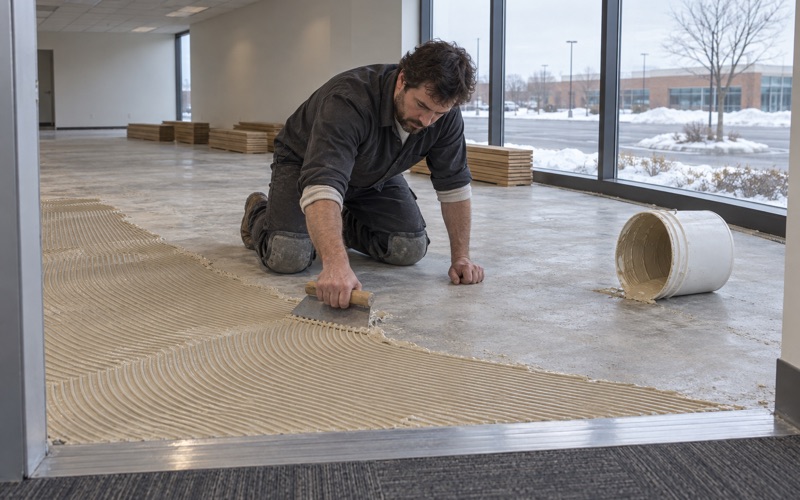
We sequence installation work around the heating season rather than in spite of it. New flooring delivered in January acclimates inside the house it will live in, not in a garage, and we check the moisture content of the material against the subfloor before a board goes down instead of after. Boards laid at the wrong moisture content in a dry house will move when humidity returns in spring, and that movement becomes gapping the new owner reports in their first summer.
For a seller the practical version is short: a floor installed in February carries a different acclimation window than the same floor in September, and that window belongs on the schedule rather than being absorbed quietly at the end of it.
What a mid-century floor here usually turns out to be
Bloomington’s housing stock is largely postwar. The 1950s are the single largest build decade at 22.3 percent of units, with the 1970s at 20.5 percent and the 1960s at 17.7 percent, so 60.3 percent of the city’s housing went up across those three decades. Owner-occupied stock skews detached as well: 18,876 owner-occupied units, 76.4 percent of them, are single-unit detached houses.
Under the carpet
In practice that means ramblers and split-levels, and under the carpet in a great many of them is red oak strip flooring, site-finished, tongue-and-groove, nailed down over a plywood subfloor. Often it has never been sanded, which is the best news available, because the full thickness is still there to work with.
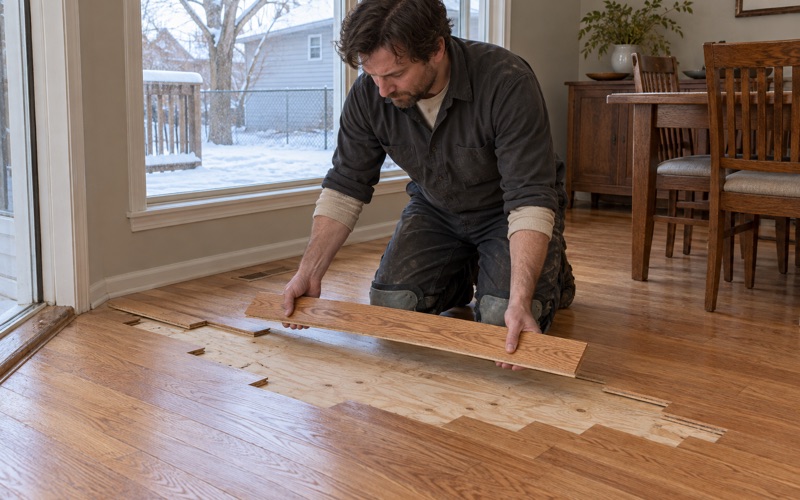
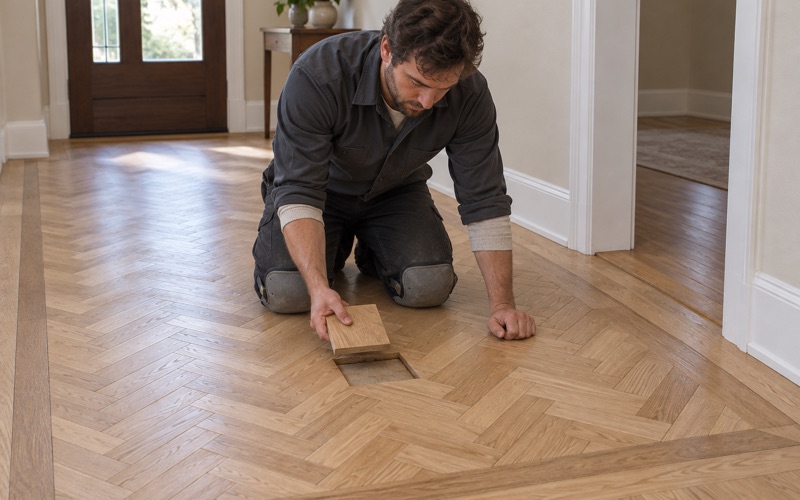
What those floors usually need is board replacement rather than wholesale work. A weave-in where a wall came out, a dutchman patch at an abandoned floor register, a strip or two where a radiator once leaked. Done before the sand, those repairs disappear into the floor. Done after it, they show up in every listing photograph.
Species, and what a stain will and will not do
Red oak carries stain more evenly than hard maple and hides more of what is underneath it; maple is usually better left natural or finished with a hardwax oil than pushed dark. Where a mid-century house has white oak in one room and something else in the hallway, matching a new run to the old one is a species and grade question before it is ever a finish question.
We say which of those is realistic in the days available. Two weeks before a listing is not the moment to attempt a color match that needs three sample boards and a week of thinking.
The pre-1978 question
With 66.8 percent of the city’s housing units built before 1980, most of these houses sit inside the EPA RRP lead-safe rule. That rule governs how painted surfaces are disturbed, and floor sanding runs an edger along painted baseboards for the length of every wall in the room.
It changes the setup and the containment on the job rather than the floor itself, and it is one more reason a calendar running toward a listing wants a few days of margin built into it.
If it is a townhouse or a condominium
The time-of-sale requirement covers condominiums and townhouses as well, and a large share of Bloomington’s newer construction has been multifamily rather than detached, with 19.2 percent of all housing units sitting in buildings of fifty units or more. Hard-surface flooring above another unit almost always has an association rule behind it, written around impact insulation class and sound transmission class, commonly an assembly rated 45 in each.
We get the association and board paperwork settled before an upstairs job starts. A crew stopped halfway through by a board that never approved the underlayment is the worst thing that can happen to a floor with a listing date in front of it.
- 20+ Years Experience
- Free Written Estimates
- Dust Containment on Every Sand