Burnsville Wood Flooring has spent more than twenty years installing, sanding and refinishing wood flooring in Chanhassen and across the south and west metro. Two kinds of floor come up here more often than anywhere else on our map: floors in rooms the public walks into, and floors in houses that all went in during one busy decade. We quote them as two different problems, because that is what they are.
A floor carrying visitors is judged on how it looks under bright light on a booked evening, and it has to be out of service for the shortest stretch of days anyone can arrange. A floor in a family’s house is judged slowly, over years, and the live question is usually whether it needs a full sand or something lighter and cheaper. Neither answer comes from looking at the boards.
The first visit is a measuring visit either way. We take an indoor relative humidity reading with a hygrometer and write it on the estimate, put a moisture meter on the flooring and on the subfloor beneath it, and hand back a written grit sequence and finish schedule alongside the price. The crew that takes those readings is the crew that rolls the final coat.
Floors in rooms the public walks into
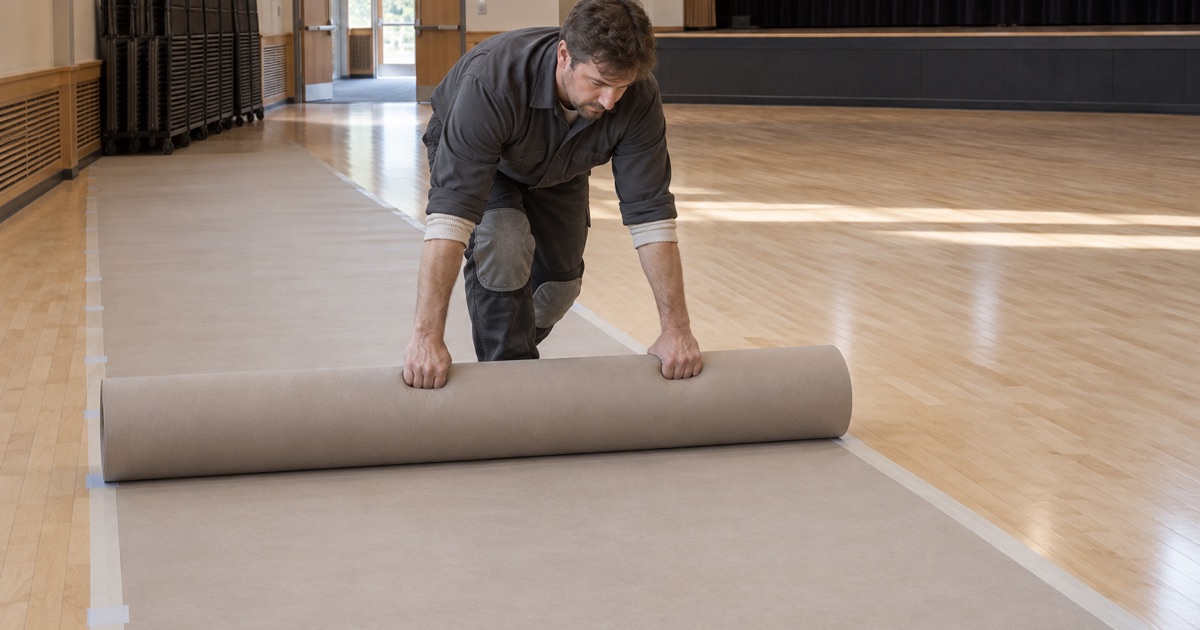
Chanhassen holds an unusual number of buildings that open their doors to visitors. Chanhassen Dinner Theatres is described as the nation’s largest professional dinner theater, and Paisley Park, the Minnesota Landscape Arboretum, the Eckankar Temple of ECK and a National Weather Service forecast office all sit inside the same city limits. We name them as a description of the city rather than a customer list, and the practical point is that a real share of the wood floors here are walked on by strangers instead of by one household.
Wear arrives in a lane
A household spreads its steps across a floor over the course of a day. A lobby, an entry or a corridor into a hall concentrates the same traffic into a strip a few feet wide, and that strip goes dull, then scratches through the finish, while the boards ten feet away still look new. We map that lane on the walkthrough instead of pricing the room as one flat surface, because the honest answer is often a heavier build of finish on the path and a standard build everywhere else.
Point loads, not uniform wear
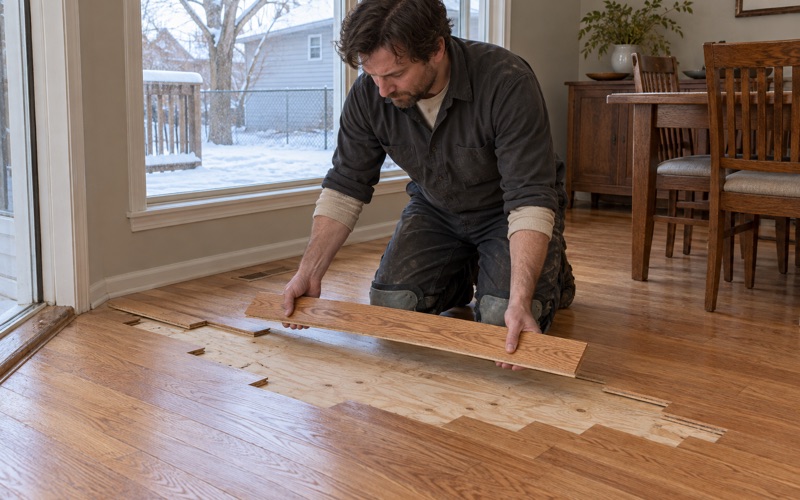
Chairs dragged back from tables, cases on casters and rolling staging put weight through very small contact patches. That produces individual crushed or split boards rather than an evenly tired floor, so board replacement, a weave-in at a doorway or a dutchman patch around a fixture is usually in the scope before a sander is switched on. We price that repair as its own line rather than burying it in a square-foot number.
Installing into a slab-on-grade room
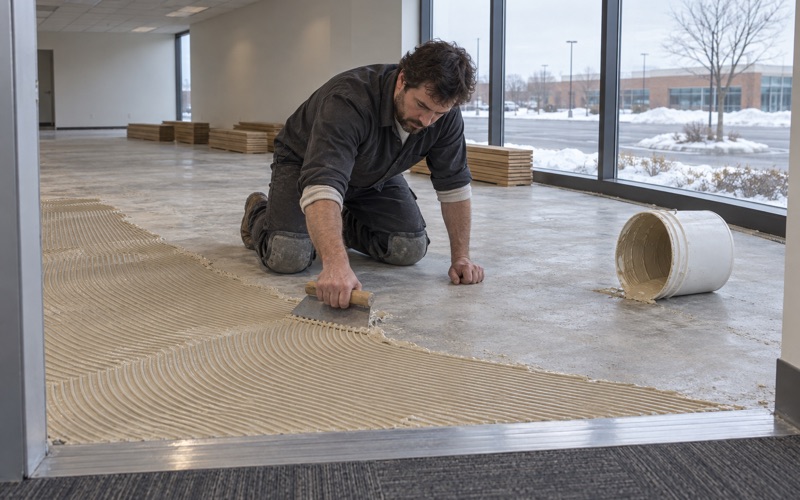
A good share of the newer public rooms in town sit on slab rather than on a plywood or OSB subfloor, and that changes an installation more than the species choice does. We run an ASTM F2170 in-situ relative humidity test in the slab, compare the moisture content of the flooring against the substrate before a board goes down, and choose between a glue-down assembly over a vapor retarder and a floating floor on the strength of that reading. Acclimation follows the room’s own service conditions and the NWFA installation guidelines, not a fixed number of days on a delivery ticket.
Species, and what is left to sand
Most of what we find in these rooms is white oak or red oak, with hard maple where somebody wanted a brighter room and accepted a floor that records every dent. On engineered flooring the first question is not species but wear layer, and we measure it before quoting a refinish, because past a certain thinness there is nothing to sand and a drum sander cuts straight through the veneer. When the reading comes back short we say so and quote maintenance instead of a refinish nobody can deliver twice.
Looking for wood-flooring closer to St. Paul? See Wood-Flooring in St. Paul.
Scheduling around a calendar booked months ago
Cure time is not dry time
A waterborne polyurethane can be walked on in socks the same evening and recoated the next morning, which is why it wins most of the jobs where a room has to come back quickly. Full cure runs on a separate clock: the film keeps hardening for days after it stops feeling wet, and that is the window in which a rolling case or a rubber-backed rug prints into it. We put both dates on the finish schedule and plan the return to service against the cure date, not the dry one.
Sequencing with the heating season
Sanding and coating in January is ordinary work in Minnesota, but it has to be sequenced around the heating system rather than in spite of it. Forced-air heat running dry pulls the moisture content of a floor down while the coating is going on, and a floor coated at one moisture content and used at another moves under a fresh film. Where a building runs a whole-house humidifier we ask for it to be set before the first cut and left alone for the run of the job.
Dust containment, and what it does not catch
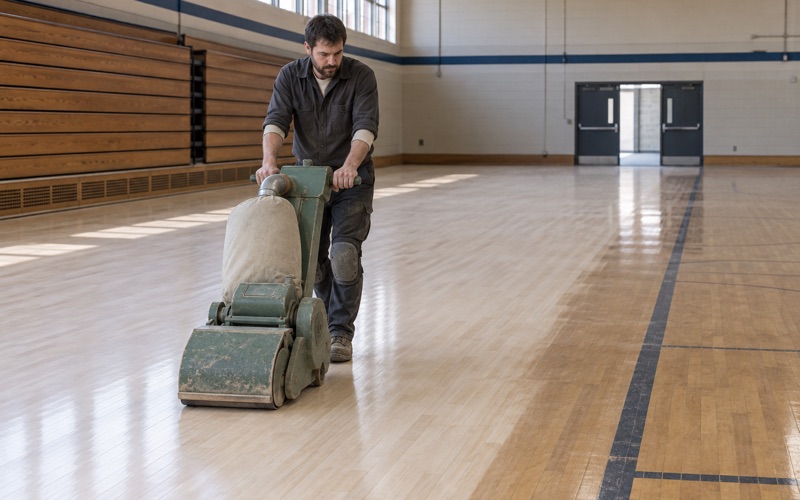
Every sanding job we run is contained: shrouded drum sander and edger, sealed openings and negative pressure at the work area. Containment takes the great majority of what comes off a floor, and it does not take all of it, so fabric, open shelving and instruments in the adjoining room still want covering or moving. Saying that at the estimate is easier than arguing about a dusty ledge afterward.
Who signs off on the work
Interior finish work of this kind generally falls under the Minnesota Rules 1300.0120 finish-work permit exemption, and the Minnesota State Building Code is administered here by the City of Chanhassen. Where a floor is one part of a larger remodel that does need a permit, the application belongs to the general contractor and we schedule into it rather than around it.
Choosing a finish for a floor the public walks on
The three families we quote
Waterborne polyurethane suits most public-traffic floors: it builds quickly, stays clear instead of ambering, and accepts a maintenance coat without a long shutdown. Oil-modified polyurethane is harder to fit around visitors because of odor and a slower cure, though it warms red oak in a way some rooms are built around. Hardwax oil is the third option, and it earns its place where spot repair matters more than outright film hardness, since a scuffed area can be cleaned and re-oiled without touching the rest of the room.
Sheen is a wear decision as much as a look
A high gloss floor telegraphs every scuff and every traffic lane under raking light, which is precisely what a room full of people under evening lighting does to it. Satin and matte sheen levels scatter that light and buy months between maintenance coats, and on a floor with one defined entry path that can be the difference between recoating twice a year and once. We set the sheen level in the written finish schedule rather than leaving it to a conversation on the day of the last coat.
Plan the recoat before the first coat
The cheapest floor to own is the one that gets an abrasive screen and a fresh coat while the wear is still inside the finish. Once a traffic lane has gone through the film into bare wood the screen-and-recoat is off the table and the room needs a full sand at several times the cost. We propose a recoat interval with the quote, based on the lane we measured, and we would rather look at a floor, say it is fine and leave than come back to a sand-through.
The residential half: 1990s houses at a first refinish
A cohort arriving at the same decision
The largest single build cohort in Chanhassen is the 1990s, at 27.5 percent of 10,186 housing units, with another 33.7 percent built in 2000 or later. Owner occupancy runs 84.1 percent of occupied units, so a great many of those floors have carried one family the whole time. Three decades of that is about when a site-finished oak floor stops answering to cleaning and starts needing abrasives.
Recoat, or come back to bare wood
Not every one of those floors needs a full sand, and we quote both paths so the choice is visible. Where the wear sits in the finish and the boards are flat, a screen-and-recoat is the right job at a fraction of the price; where there is graying at the doorways, pet damage or an old sand-through, the floor has to come back to bare wood and take the 36-50-80 grit sequence. Saying which one applies, in writing, before any money moves is the whole point of the visit.
Winter movement, before anyone calls it a defect
Footings here go deep. Carver County and Hennepin County are both named in Minnesota Rules 1303.1600 Zone II, where the minimum allowable footing depth due to freezing is three and one-half feet, which is a large reason these houses have full basements and conditioned space under the main floor. Even so, a heated Minnesota house in January drops out of the thirty to fifty percent relative humidity band a wood floor is specified for, and the floor answers with seasonal gapping and occasionally dry cupping. We measure and photograph that movement rather than pricing it as damage, because a good share of it closes again by June.
Water damage is documented before it is torn out
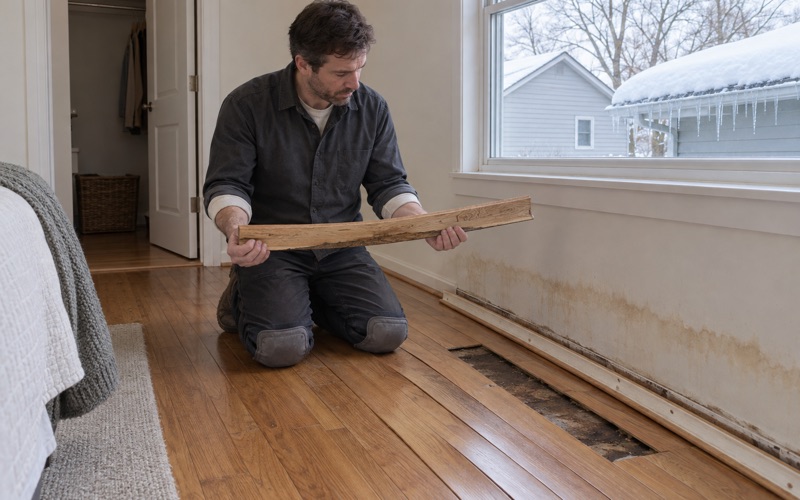
A supply line behind a dishwasher or an ice dam finding its way down a wall does not stay a small problem in a wood floor. Before anything comes up we photograph the affected area, record moisture meter readings across the wet zone and the dry boards around it, and write down what we found, so the claim is argued from a record instead of a memory. Then we quote the repair on its merits, which is sometimes a section of board replacement woven into the existing floor and sometimes the whole run.
Upstairs floors and shared walls
19.6 percent of all housing units in the city sit in attached structures of two or more units, and those jobs start with paperwork rather than with a sander. Association rules written under the Minnesota Common Interest Ownership Act commonly set a sound requirement for hard surface above another unit, often expressed as impact insulation class 45 and sound transmission class 45. We get board approval and the underlayment specification settled before a delivery is scheduled, so nobody stops the work halfway through the second day.
- 20+ Years Experience
- Free Written Estimates
- Dust Containment on Every Sand