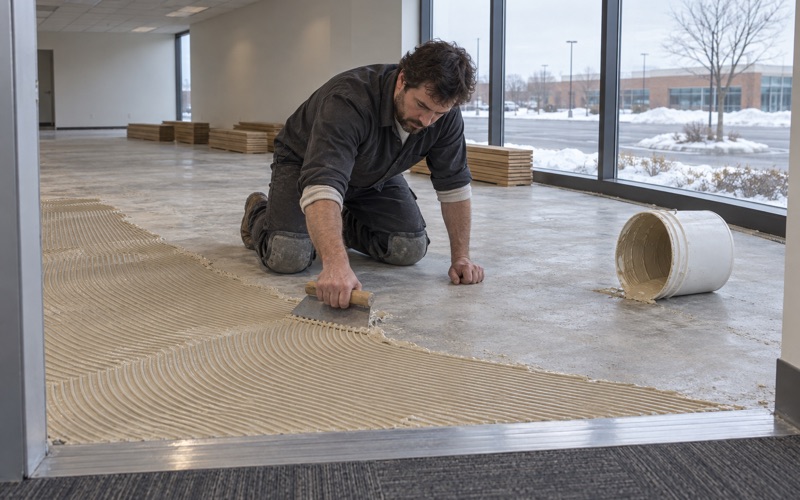
Burnsville Wood Flooring has spent more than twenty years on wood flooring in Cottage Grove, and a fair share of that work begins with a carpet knife instead of a sander. Under the padding in a lot of houses here sits a site-finished strip oak floor that was covered over within about ten years of being laid. Bringing one of those back is a different job from installing new, and the difference belongs in the estimate rather than in a surprise partway through.
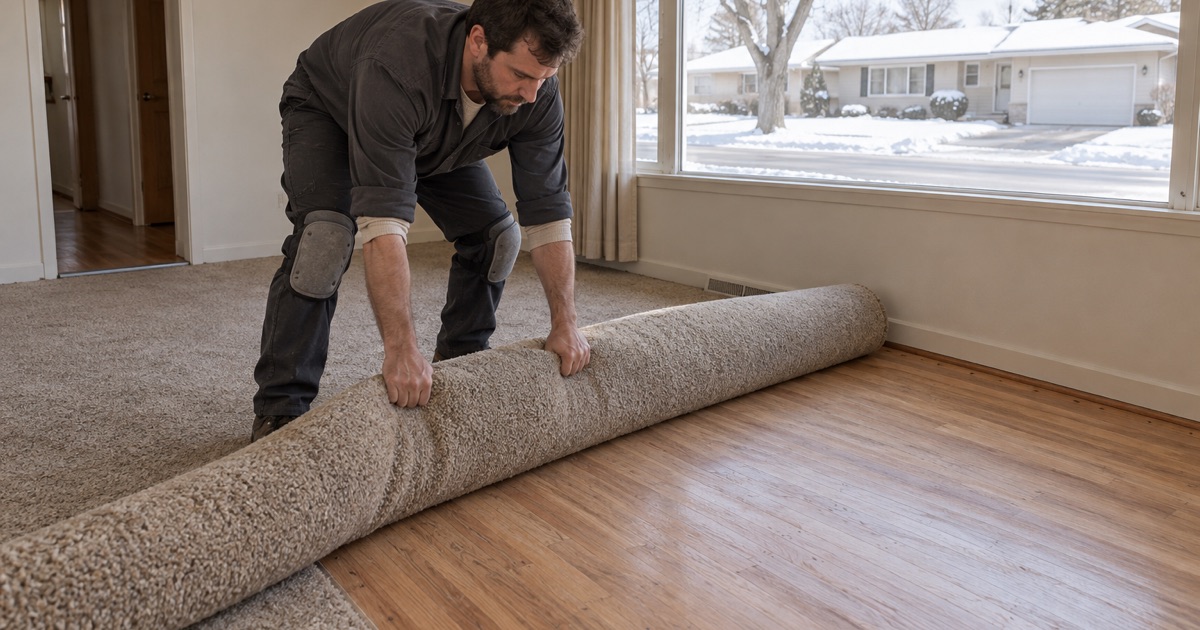
Recovery work pays for patience at the front end. We lift a corner in a closet, look at what the tack strip and the pad staples actually did to the boards, and put a moisture meter on the floor and the subfloor before anyone talks about grit. A floor with thickness left above the tongue and sane moisture readings is usually worth saving, and the one that is not is far cheaper to identify in an hour than on day three of a sand.
What follows is how we read a concealed floor in this part of Washington County, what tends to be under the carpet in the houses that make up the bulk of the older stock, and the cases where covering the wood was the right call and still is. None of it asks you to commit to a sand before anyone has seen the boards.
Thompson Grove and the ranch cohort behind it
The city sits on the north bank of the Mississippi River about ten miles south of Saint Paul, and it spent most of its first century as farm country. Suburbanization arrived in the 1950s with Thompson Grove, a development of ranch-style houses, and the population went from 833 in 1950 to more than 4,800 in 1960. Those ranches set the pattern that the next two decades of building followed.
The stock that hides a floor
Of the city’s housing units, 9.4 percent were built before 1960, and the 1960s and 1970s together hold 27.8 percent, so 37.2 percent of everything here predates 1980. That is the band where a site-finished floor under carpet is a reasonable bet rather than a long shot. By contrast, 31.5 percent of units were built in 2000 or later, and those floors tend to be prefinished or engineered and were never carpeted over in the first place.
Owner-occupancy runs 88.2 percent of occupied units, which quietly changes the economics of recovery. A floor you intend to live on for another fifteen years justifies a full sand in a way a floor being turned over for sale does not, and we quote it that way.
Rental property carries its own timing. The city requires a rental license for every non-owner-occupied dwelling, accessory apartments excepted, with single-family rentals inspected every other year. Owners weighing recovery against fresh carpet usually want the sand scheduled between tenancies, and that is a calendar question worth raising early rather than late.
Why the carpet went down in the first place
Carpet over new oak was ordinary practice in that era, not a mistake somebody made. It was warmer underfoot above a cold basement, it was cheaper to replace than a finish was to renew, and a builder-grade oak floor was treated as an underlayment about as often as a finished surface. The result is that the wood beneath is frequently in better shape than the homeowner expects, because it stopped taking foot traffic decades ago.
Looking for wood-flooring closer to Victoria? See Wood-Flooring Services in Victoria.
What is usually under the carpet in a house of that age
In the ranch cohort the common find is narrow strip red oak, tongue-and-groove, nailed down with cleats over a plywood or board subfloor and finished in place. It reads dark and blotchy under the pad because the original finish ambered unevenly wherever light and furniture varied. That coloring almost never survives a sand, so the floor you uncover is not the floor you will end up living with.
Tack strip, staples and adhesive
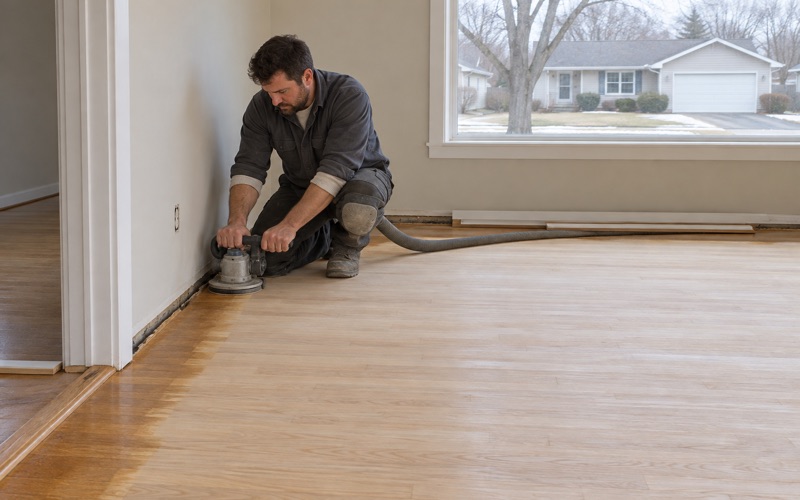
Tack strip damage is a perimeter problem: a line of nail holes an inch or two off the base, sometimes doubled where the carpet was replaced once along the way. Pad staples leave a scatter across the field, and most of them come up under a drum sander, while the ones driven flat have to be pulled rather than sanded over. Adhesive is the harder case, because a later glue-down carpet or a resilient layer can leave a film that loads abrasive and burnishes the surface instead of cutting it.
We check all three before quoting, since each carries a different cost and only one of them is unpredictable. Adhesive is what turns a two-day sand into a three-day sand, and we would rather say so at the estimate than revise the number midweek.
Stairs, thresholds and the edges of the room
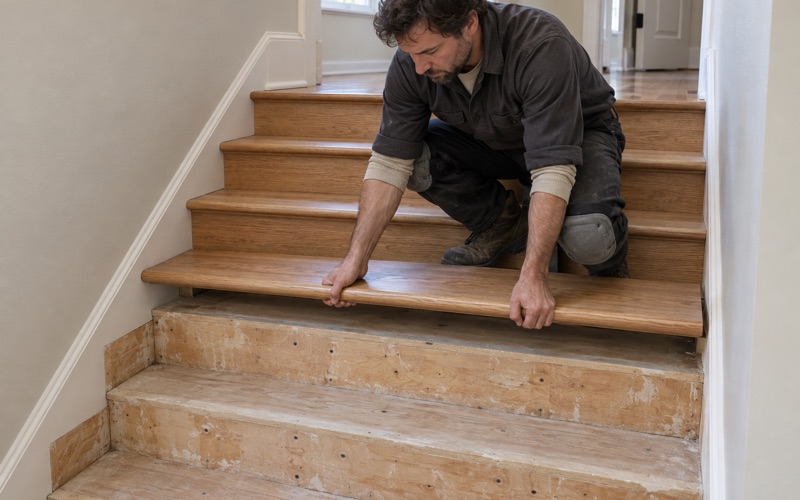
Carpet rarely stopped at the room line, so the edges tell you what else changed over the years. Stair treads that lived under a runner are often construction-grade with a nosing nobody expected to be seen, and the skirt along the stringer hides some of the roughest cuts in the house. Thresholds are the other tell, because a reducer or T-mold sitting proud of the field usually marks a covering that came and went, and the strip beneath it may have been trimmed to suit.
Paint, and the rule that comes with it
Housing built before 1978 falls under the federal lead-safe renovation rule, and Minnesota is not an authorized state for that program, so the federal Environmental Protection Agency rule governs renovation disturbing paint in those homes. An edger running against a painted baseboard disturbs paint, which is why the question reaches a floor job at all. On a house from the Thompson Grove era or the two decades after it, we plan containment and the base treatment around that rule rather than discovering it on the first morning.
Judging a recovered floor before committing to a sand
The opening question is how much wood is left above the tongue, because that thickness is the entire budget for every sand the floor will ever get. A floor already sanded once, or worn through at a doorway, may have room for one light pass and nothing beyond it. We measure instead of eyeballing, and where the material turns out to be engineered rather than solid we measure the wear layer, since past a certain point there is nothing left to sand.
Moisture, from below as much as from inside
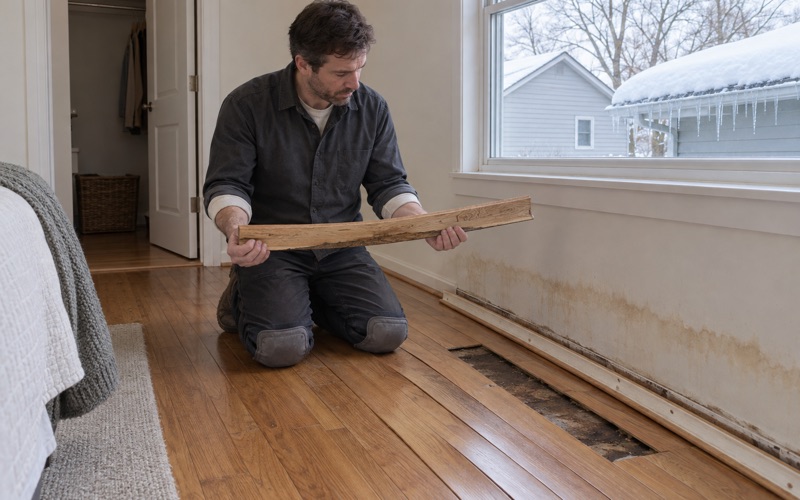
A basement under the main floor changes the moisture picture, and basements are the regional norm here: full or partial basements were 62.3 percent of West North Central single-family starts in 2024. Where there is one, the underside of the floor lives in a different relative humidity than the room above it, and a moisture content differential across the thickness of a board is what produces cupping. We read both faces with a meter, set a hygrometer in the room, and write those numbers down on the first visit rather than recalling them later.
Defects that are repairs, not disqualifications
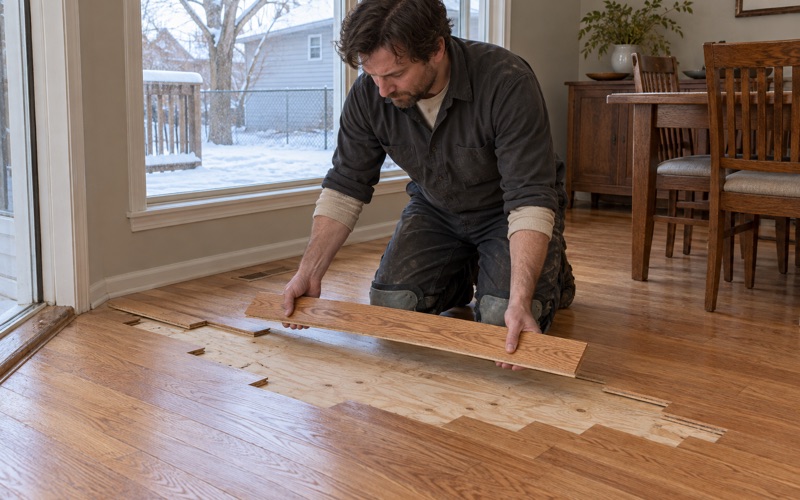
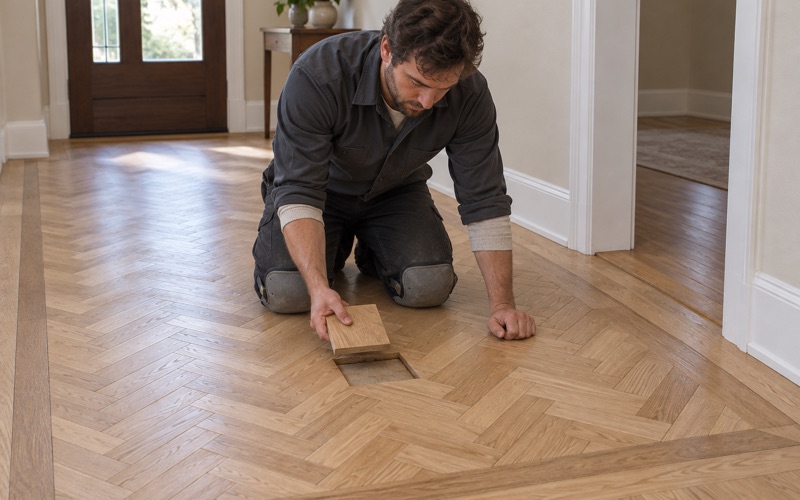
Missing boards at an abandoned register cut, a hearth patch in the wrong species, or a stretch chewed up by a pet are board replacement problems, not reasons to give up on the floor. We weave in replacements so the end joints break against the surrounding field, and a small hole in an otherwise sound run takes a dutchman patch instead of a whole board. Lathe checks and overwood show themselves after the first cut and get handled inside the sequence, not as a mystery line on an invoice.
Species and cut decide whether a patch disappears or announces itself. Red oak takes stain differently than the white oak that turns up in a later repair, and a quartersawn board dropped into a plainsawn field reads as a stripe once the finish goes on.
What the quote puts in writing
Every recovery quote leaves here with the grit sequence and the finish schedule on it, so a 36-50-80 progression is something you can hold the crew to rather than something you have to trust. Where the original finish came through the carpet years in decent shape, we price a screen-and-recoat honestly against a full sand, including the cases where the abrasive screen is the right answer and the drum sander is not. Interior finish work of this kind is exempt from permit under Minnesota Rules 1300.0120 subpart 4 item A sub-item 8, while that same subpart preserves every other code and ordinance duty, administered here by the City of Cottage Grove.
When the carpet was the kinder answer and still is
Some floors should stay covered, and saying so costs us work we would rather not have taken. A floor sanded twice already, one flooded and cupped hard enough to have crowned as it dried, or one with adhesive ground into an already thin face is a floor where new covering is the honest recommendation. We would rather tell you that at the estimate than after the tack strip is in a dumpster.
The heating season is the real constraint
Forced air is how this metro heats, with 89.1 percent of owner-occupied homes on a warm-air furnace, and a furnace running through a Minnesota January pulls indoor relative humidity well under the thirty to fifty percent band, at sixty to eighty degrees Fahrenheit, that wood flooring is specified for. That is why we read humidity on the first visit and raise the subject of a whole-house humidifier before anyone picks a board width. Seasonal gapping in a recovered floor gets measured and explained before it is called a defect, because a good share of it closes again by June.
Sequencing, dust and who is actually in the house
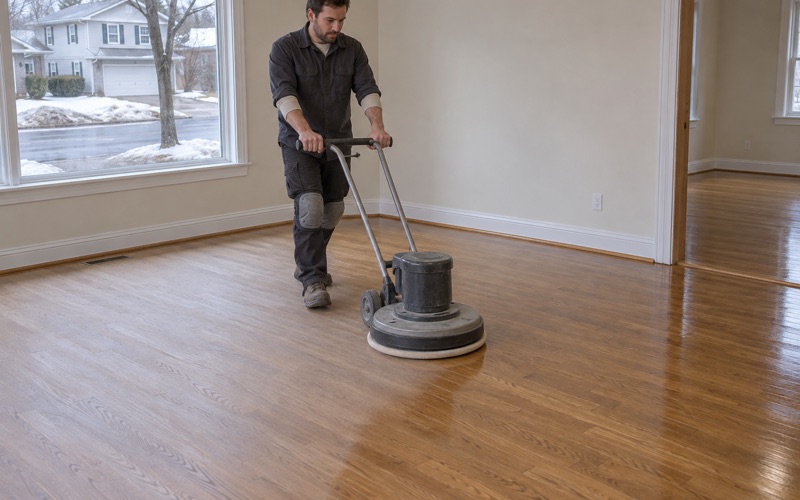
We schedule recovery work around the heating season rather than in spite of it, which sometimes means the sand waits a few weeks for the house to settle toward a stable equilibrium moisture content. Dust containment runs on every sanding job, and we will tell you plainly what it does not catch instead of promising a dustless sand. Cure time is not dry time, and whether the finish is a waterborne polyurethane or an oil-modified one changes how long the room stays off limits and what sheen level you live with afterward.
The same crew that walks the floor at the estimate is the crew that rolls the final coat. On a recovered floor, where half the decisions only become possible once the carpet is gone, that continuity is most of what you are buying.
- 20+ Years Experience
- Free Written Estimates
- Dust Containment on Every Sand