Burnsville Wood Flooring installs, sands and refinishes wood flooring in Eagan, and we have been doing that work across the south metro for more than twenty years. Most of what we are called out for here is not a bare new house. It is a floor that has been walked on since the middle of the 1980s and has finally started to look it.
Every estimate here starts the same way. We read the indoor relative humidity with a hygrometer and write the number down, we check the moisture content of the subfloor against the moisture content of whatever is going over it, and on engineered flooring we measure the wear layer before we will put a refinish price on paper. Those three readings decide most of what follows, and none of them is guesswork.
What you get back is a written grit sequence and finish schedule attached to the quote, so the finished job can be checked against something. The crew that measures the floor is the crew that lays the last coat.
A third of the city went up in one decade
Eagan holds 28,789 housing units, and 9,658 of them, 33.5 percent, were built in the single decade of the 1980s. The 1990s are second at 22.9 percent. No other decade in the city’s history comes close to either.
That concentration changes what the phone calls look like. A city whose housing went up steadily over sixty years gets floors failing steadily. A city that built a third of itself in ten years gets floors reaching the end of their service life in a batch, and that batch is arriving now.
Floors that all turned forty together
A wood floor installed in 1984 has been through roughly forty heating seasons. If it was site-finished solid oak, it has probably been sanded once somewhere along the way and is now due for a decision rather than a touch-up. If it was one of the engineered or laminate products the decade was fond of, it is at or past the end of what it was built to give.
We see the same three or four original specifications over and over in these houses, which is the one convenient thing about a build cohort this concentrated. By the time we walk into a living room we usually have a good idea of what sits under the finish. That does not replace measuring it, but it does mean we arrive with the right abrasives on the truck.
The stock that decade left behind
Owner-occupied housing here is overwhelmingly single-family: 13,748 owner-occupied units are one-unit detached, 71.8 percent of the owner-occupied total, with another 4,218 one-unit attached at 22.0 percent. The detached houses are where the solid strip flooring lives.
The city was settled as an Irish farming community and only incorporated in 1972, which is part of why so little of it predates that building boom. The 1980s were not a redevelopment wave here. They were the first wave, and there is very little older flooring underneath them to complicate a job.
Looking for wood-flooring closer to Richfield? See Wood-Flooring Services in Richfield.
Where a forty-year-old site-finished floor usually stands
Solid three-quarter-inch red oak strip, nailed down over a plywood subfloor, is the default we find in these houses. It is a good floor with life left in it, but four decades of traffic and one previous sanding change what can safely be done to it now.
How much wood is left above the tongue
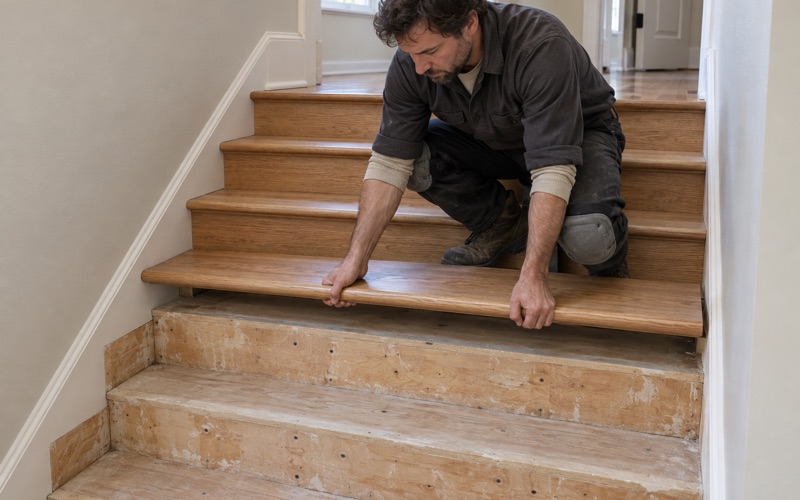
A solid strip floor can take several sandings over its life, and the limit is the wood sitting above the tongue-and-groove. We check that depth at a floor register, a stair nosing or a threshold where the edge of a board is exposed, and we read the previous sander’s work at the same time. Heavy edger swirl, overwood at the board ends, or a sand-through at a doorway all say how aggressive the last pass was.
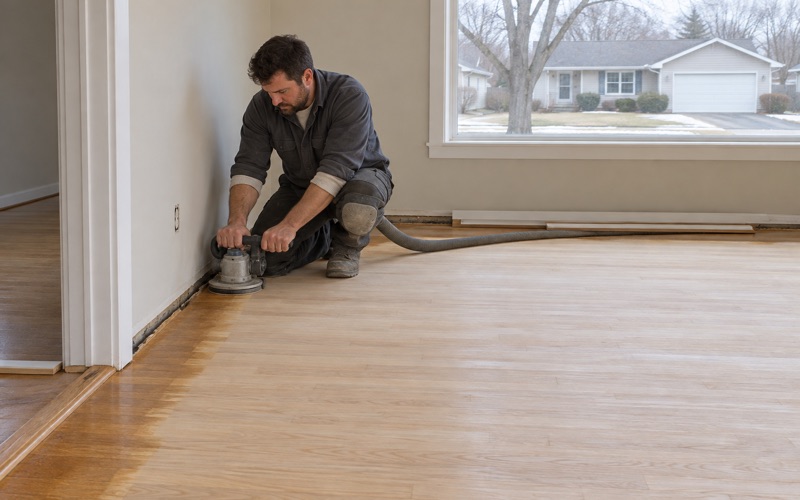
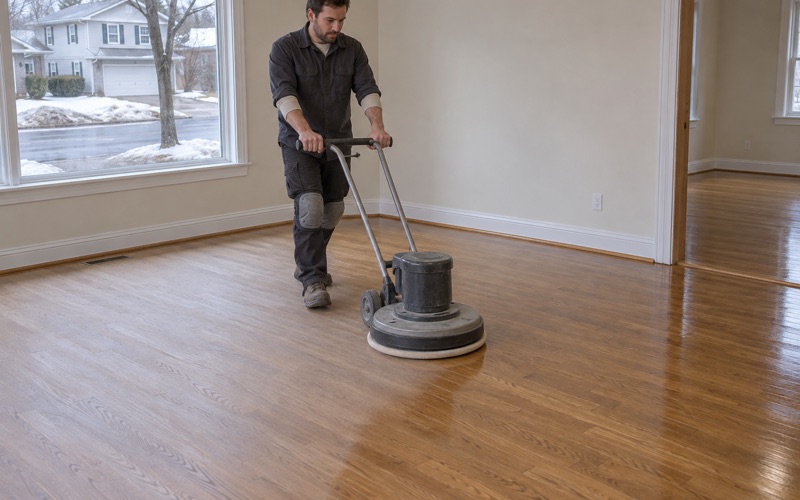
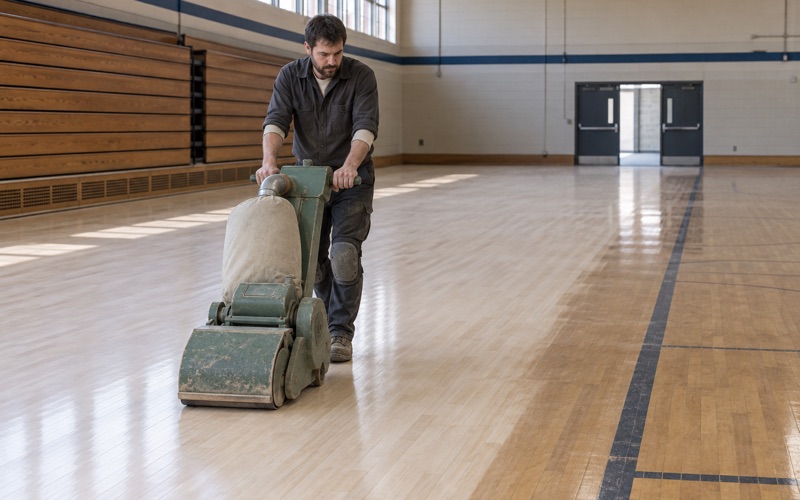
Where there is room, a full sand runs a 36-50-80 grit sequence with a drum sander, an edger into the perimeter, and a buffer to blend the two before finish goes down. Where there is not much room left, a screen-and-recoat with an abrasive screen takes the scratches out of the finish rather than out of the wood, and buys years without spending thickness. We quote the cheaper one when the cheaper one is right, and we put that in writing rather than leaving it as a conversation.
Gapping in January is not a defect yet
Forced-air heat pulls indoor relative humidity well below the thirty to fifty percent band wood flooring is specified for, and a floor that sat at a comfortable equilibrium moisture content all summer shrinks. Thin dark lines between boards in January, and dry cupping where board edges sit slightly proud, are the ordinary end of that cycle in a Minnesota house.
We measure the gaps, photograph them and explain them before anyone calls the floor failed, because a good share of that movement closes again by June. What we treat as a genuine problem is gapping that never closes, cupping that persists into summer, or crowning left behind when someone sanded a cupped floor flat while it was still wet underneath. A whole-house humidifier saves more of these floors than a sander does.
Additions and closed-in porches
Dakota County is named in Minnesota Rules 1303.1600 Zone II, where the minimum allowable footing depth due to freezing is three and one-half feet. Where a deck or three-season porch from that era was later closed in and floored, we look at what is under it before quoting hardwood. A shallow, unheated or thinly insulated floor cavity moves seasonally in a way the rest of the house does not, and the boards over it show that first.
Builder-grade engineered and laminate at the end of its life
The 1980s put down a great deal of thin engineered flooring and a great deal of early laminate. Both are now at the point where the honest answer is sometimes that there is nothing left to refinish.
We measure the wear layer before we quote
Engineered flooring is a wear layer of real wood over a manufactured core, and only that top layer can ever be sanded. Builder-grade product from this era often carries a wear layer of a millimeter or two, and part of that was already spent on the factory finish and on any sanding done since.
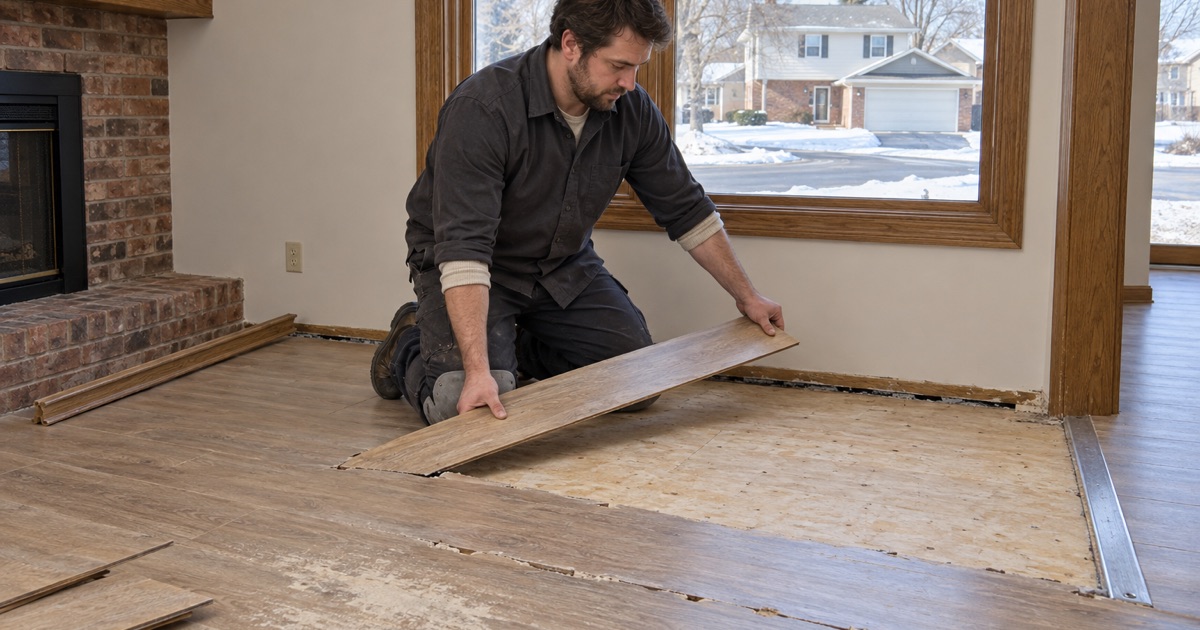
We measure it at an exposed edge, usually a register cut, a transition or a lifted threshold, before a refinish price goes on the quote. Past a certain thickness there is nothing left to sand, and a contractor who quotes a full sand on that floor is quoting a sand-through. When the number comes back short, we say so and price replacement or a recoat instead of taking the job on hope.
Laminate is a different conversation
Laminate is a printed layer over fiberboard. It cannot be sanded at any thickness, and a water event that swells the core is not repairable. Where a laminate floor of that vintage has failed in one room, replacement is the only path, and the useful part of the discussion is what goes down next and how it meets the flooring in the adjoining rooms with a reducer, T-mold or threshold.
Attached homes and the paperwork above them
Nearly a fifth of the housing here, 19.6 percent or 5,637 units, is one-unit attached, and another 4,634 units, 16.1 percent of the stock, sit in structures of fifty or more units. In those buildings the floor covering is usually governed by the association, and the specification is an impact insulation class and sound transmission class number, commonly 45, measured under ASTM E492 and ASTM E90.
We get the association and board paperwork sorted out before an upstairs job starts, underlayment included, so nobody is stopped halfway through with the old floor already out. Interior finish work of this kind is exempt from permit under Minnesota Rules 1300.0120, subpart 4, which exempts the work from a permit and nothing else. It does not set aside the association’s rules or any other ordinance.
Sanding again against starting over
Once a floor has forty years and one refinish behind it, the decision is rarely about appearance. It is about how much material remains and how long the next answer has to hold.
What tips it toward another sand
If a solid floor still measures well above the tongue, the boards are tight and flat in midsummer, and the damage stops at the finish, sanding again is straightforward and it is the cheapest good outcome on the table. Species matters here as well. Red oak and white oak sand and take stain predictably, hard maple and hickory are harder and less forgiving of a heavy grit, and American walnut is worth extra care because nothing about replacing it is cheap.
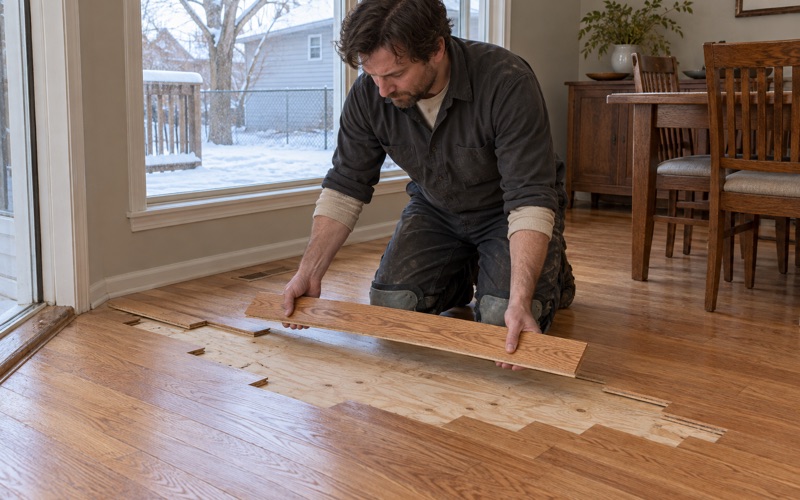
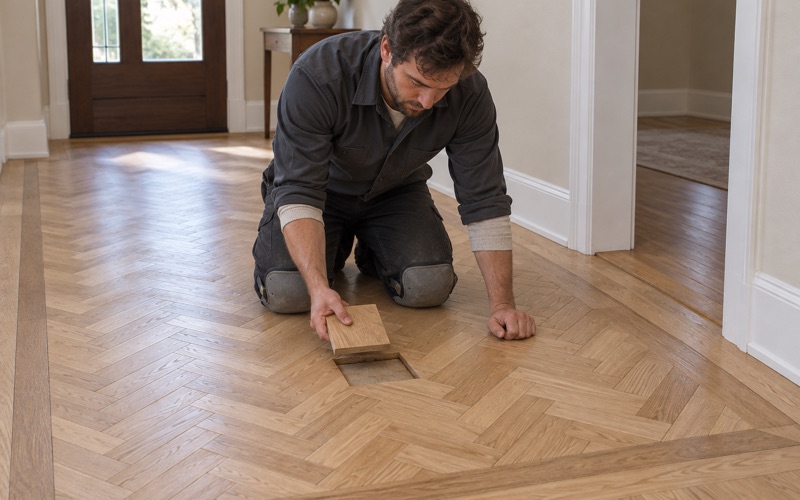
Localized damage does not force a whole-house decision either. A row of boards ruined at a dishwasher line or a patio door can be cut out and woven in with matching stock, or repaired with a dutchman patch, and that repair disappears under a full sand.
What tips it toward replacement
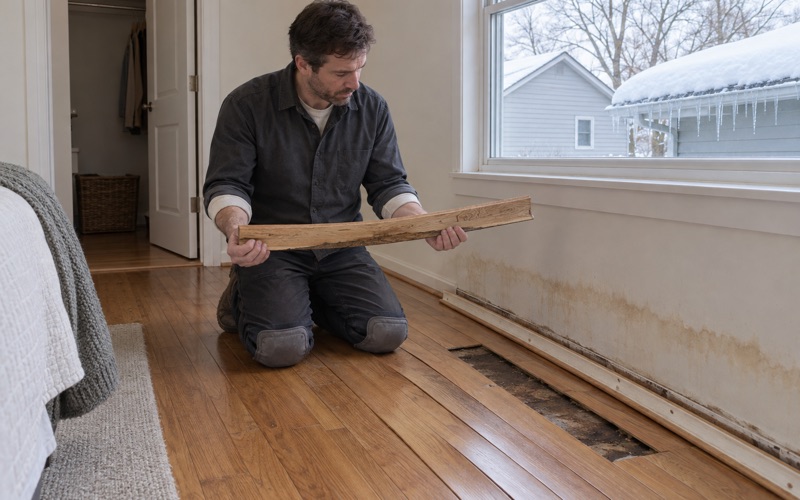
A wear layer past its limit, sand-through already visible at doorways, cupping that never releases, buckling where boards have lifted off the subfloor, or a subfloor that has been wet more than once: those are floors where one more sand buys a season and costs most of the price of doing the job properly.
Water-damaged floors get photographed and documented before anything is torn out, because once the boards are in a dumpster the claim is an argument about a floor nobody can see. Where we are matching existing material rather than replacing all of it, we record what is actually there so that like kind and quality means something specific.
How we sequence the work
Sanding and finishing is scheduled around the heating season rather than in spite of it. Waterborne polyurethane and oil-modified polyurethane behave differently, and cure time is not dry time. A floor you can walk on is not yet a floor you can cover with a rug, and we say which applies to your finish and when the furniture can come back.
Dust containment runs on every sanding job, and we will tell you plainly what it does not catch. Whichever way the decision goes, you have it on paper before we start: the grit sequence, the finish, the number of coats, and the days each one needs.
- 20+ Years Experience
- Free Written Estimates
- Dust Containment on Every Sand