Burnsville Wood Flooring has spent more than twenty years installing, sanding and finishing wood flooring in Elko New Market and across the south metro. Most of what we are called out to look at here is not an empty room waiting for new boards. It is a floor already down, somewhere between fifteen and twenty-five years old, and the real question is how much life is left in it.
So we arrive with a moisture meter and a hygrometer before we arrive with samples. The indoor relative humidity is read and written down on that first visit, the moisture content of the boards is checked against the subfloor underneath them, and on engineered flooring the remaining wear layer is measured before we will put a refinish price on paper. Each of those numbers changes what we recommend, and one of them can rule out the job you thought you were buying.
What comes back with the quote is a written grit sequence and finish schedule, so the work can be checked against something instead of taken on faith. The crew that walks the floor at the estimate is the same crew that rolls the last coat.
A town built in one decade, and floors that age on one schedule
Elko New Market is a genuinely young city. It exists in its present form because voters approved merging the neighboring cities of Elko and New Market in a March 2006 referendum that carried by 84 percent, a merger that took effect on the first day of 2007, and the 2020 census counted 4,846 residents inside it.
The housing tells a tighter story than the city limits do. American Community Survey estimates put roughly 62.5 percent of the city’s housing units in the 2000 to 2009 build decade, and around 80.4 percent built in 2000 or later, on a base of about 1,689 units. Those estimates carry proportionally wide margins here, so we read them as a shape rather than a tally, and the shape is hard to miss: most of the floors in town went in during one ten-year window.
Around 95.5 percent of occupied units are owner-occupied, and that matters more than it first sounds. Owners live on a floor for years, notice it slowly and decide about it privately, on nobody’s schedule but their own. When the whole cohort was installed inside the same decade, all of those private decisions still land within a few years of each other.
Why we ask the build year before anything else
A floor laid in 2003 under forced-air heating has now been through twenty-odd Minnesota heating seasons. Every one of them pulled indoor relative humidity well below the thirty to fifty percent relative humidity band the flooring was specified for, and the boards moved with it. What sits there today has settled into an equilibrium moisture content the original installer never measured.
At year twenty that history is visible if you know what to look for. Dry cupping shows as board edges sitting a shade lower than the centers in midwinter, most of it reversing as the house comes back up in spring. We would rather record that against a hygrometer reading than treat every seasonal shape a floor takes as damage.
That history shows up as seasonal gapping in February and as gaps that quietly close again by June. We measure winter gapping and explain it before anyone calls it a defect, because a good share of it is wood doing what wood does rather than a failure anyone needs to pay to correct.
Looking for wood-flooring closer to Cedar-Riverside? See Wood-Flooring Services in Cedar-Riverside.
What a builder-grade floor from that window usually is
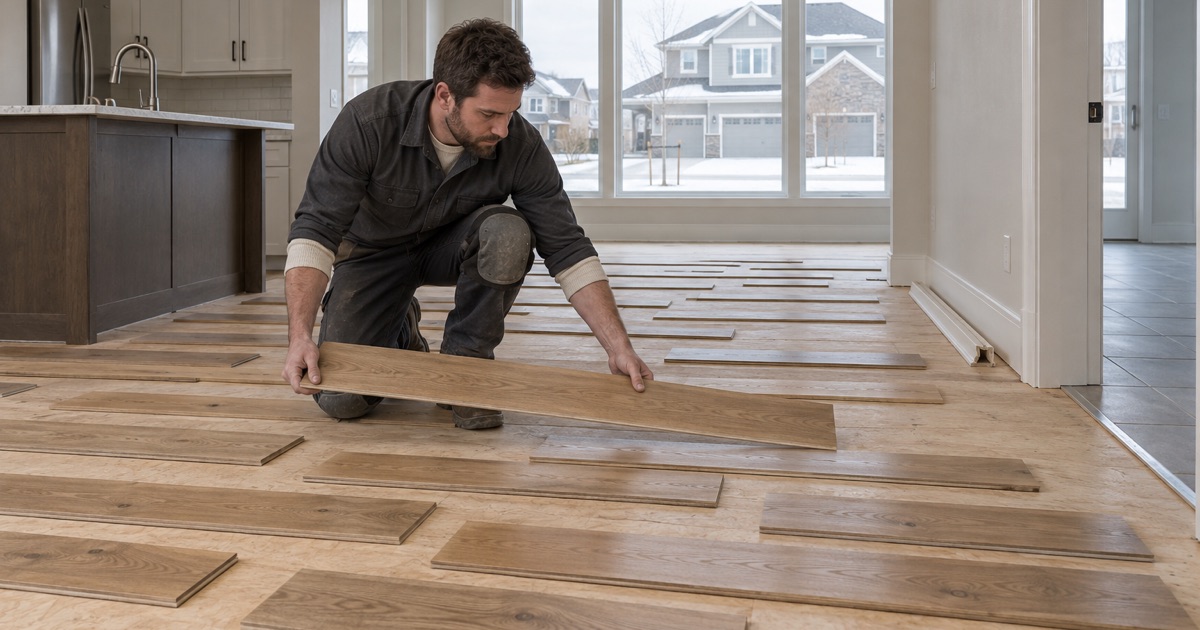
The floor packages that went into houses of this vintage are recognizable before we open the door. Prefinished red oak in a two-and-a-quarter or three-inch width, or a prefinished engineered plank, run as a nail-down or staple-down installation over a plywood or OSB subfloor, is the common pattern for the era. There are exceptions on every street, but the pattern holds often enough that we know which questions to ask first.
The wear layer decides the whole conversation
On solid red oak there is usually sanding depth left, and the conversation is about how much and how many more times. On engineered flooring it is a different question, because only the veneer above the core is available to a drum sander and the engineered core construction underneath must never see abrasive.
So we measure the wear layer rather than guess at it. Past a certain remaining thickness a full sand becomes a sand-through waiting to happen, and we would rather say so while quoting than after the floor is open. That single reading turns more refinish estimates into recoat estimates than any other thing we check.
Species and width change the sanding plan
Most of these packages are red oak, which sands predictably and takes stain evenly, but white oak, hard maple and hickory all turn up in the upgrade tiers of the same era. Hard maple is the one that punishes a rushed grit sequence, because its tight grain burnishes and shows every skipped step once finish goes over it. Janka hardness tells you how a species takes a dent, not how it takes a sander.
Width matters as much as species. A wider plank moves more across its face for the same swing in relative humidity, so a five-inch board in a January-dry house opens a wider gap than a two-and-a-quarter strip in the same room. We factor that into what we tell you to expect from the floor after the job, not only during it.
What prefinished edges do to a sanding job
Prefinished boards arrive with a factory micro-bevel on each edge, which is why a twenty-year-old floor of this type shows a fine grooved line between boards. Sanding the floor flat removes those bevels and changes the look, and it also exposes any overwood where boards sit slightly proud of their neighbors. Neither is a problem, but both are decisions, and they belong in the estimate rather than in a surprise halfway through the second day.
Recoat, refinish or replace on a twenty-year-old package
Screen and recoat
A screen-and-recoat abrades the existing finish with an abrasive screen on a buffer and lays fresh waterborne polyurethane over the top. It is the least disruptive option on the list and the cheapest honest one, and it works only where there is still finish to abrade, with no worn-through gray patches and nothing waxed or oiled sitting on the surface.
We quote a recoat straight against a full sand-and-refinish, including the times the cheaper one is the right one. We also separate dry time from cure time when we do it, because a floor you can walk on that evening is not yet a floor ready for rugs and furniture pads.
The full sand and refinish
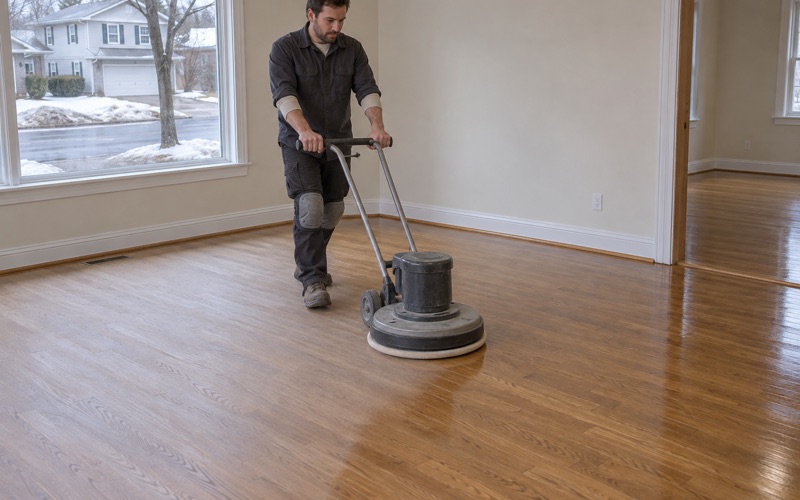
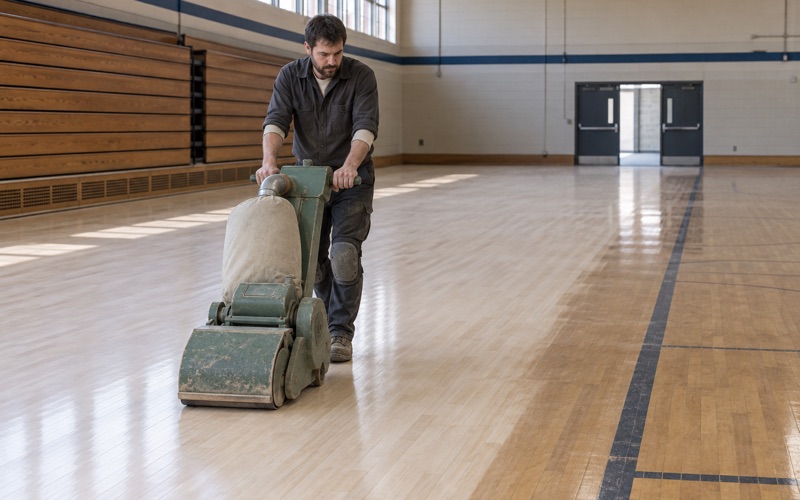
A full refinish takes the floor back to raw wood, generally on a 36-50-80 grit sequence run with a drum sander in the field, an edger at the walls and a buffer to blend, before sealer and finish go down. Oil-modified polyurethane ambers over time and wants longer between coats; waterborne polyurethane stays clearer and turns the job around faster; hardwax oil repairs in place but asks for a different maintenance habit. Sheen level gets chosen in the same conversation, and a lower sheen hides traffic patterns better than a high one on a busy main level.
Dust containment runs on every sanding job we do, and we will tell you plainly what it does not catch. Fine dust still finds the tops of door casings, and we would rather you hear that from us than discover it on your own.
When boards have to come out
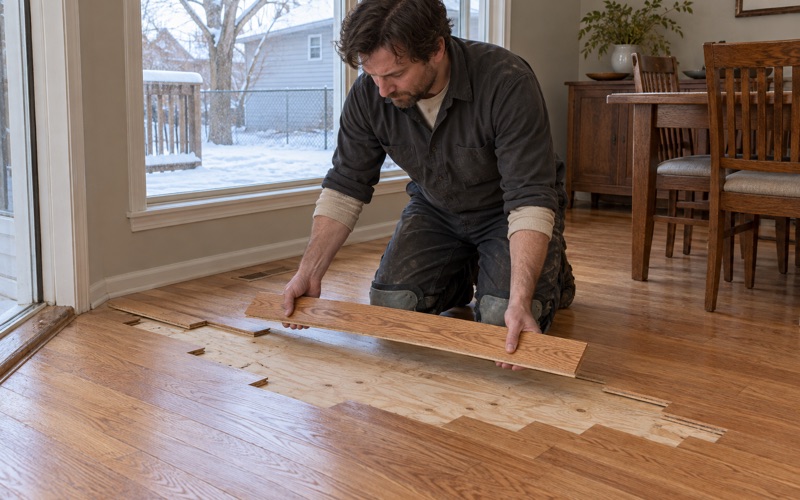
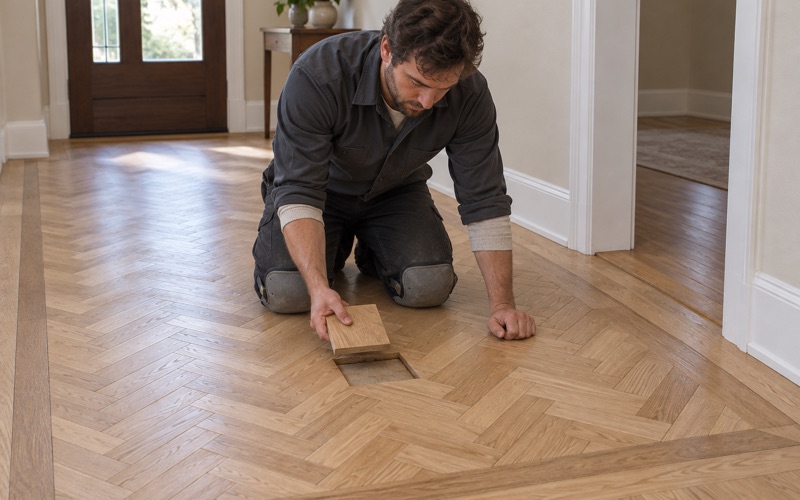
Not every floor is a whole-floor decision. A localized failure under a dishwasher or a patio door gets board replacement with a weave-in so the repair does not read as a rectangle, or a dutchman patch where one board face is damaged and the field around it is sound. Where a repair is the honest answer, we would rather repair and recoat than sell the larger job.
Matching a twenty-year-old prefinished board is the hard part of that work. Factory color and sheen have both moved since installation, so a patch usually reads best when the repair is followed by a recoat across the whole room rather than left as a spot fix. We say which of those we think the floor needs before we start, so nobody meets a second line on the invoice partway through.
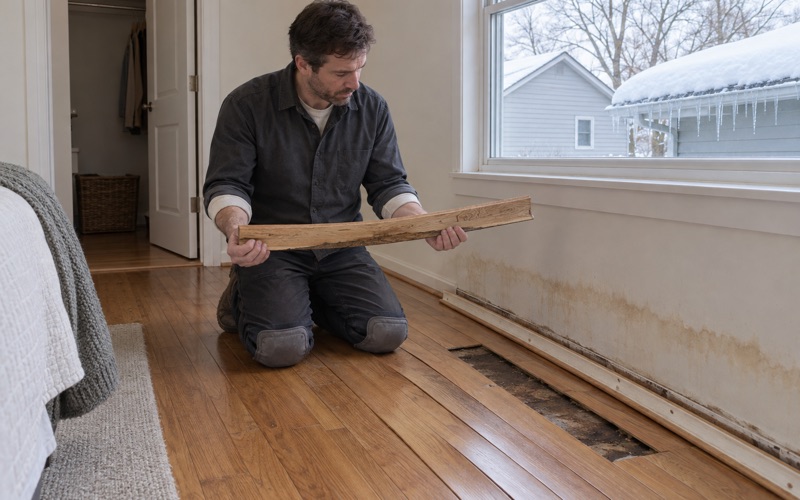
Water is the usual reason boards come out around here. Where a supply line or an appliance has let go, we photograph and document the floor for the claim before anything is torn out, because the evidence stops existing the moment demolition starts. Buckling and severe cupping are easy to read in a photograph and impossible to reconstruct from memory afterward.
Why the whole street reaches the same decision at once
The practical effect of a single-decade housing stock is that neighbors start comparing quotes in the same season. Someone on a cul-de-sac refinishes, the floor looks new again, and within a year we are estimating three more houses put up by the same builder in the same year with the same package underfoot. It is an unusual rhythm for a service business, and it is why we plan work in this city rather than fit it in.
Sequencing matters more here than it does in a mixed-age town. We schedule around the heating season instead of pretending it is not happening, because acclimation, gapping and finish cure all behave differently in a house running forced-air heating in January than in the same house in September. Where a whole-house humidifier is installed, we want to know it is working before boards are delivered rather than afterward.
Local building conditions push the same way. Scott County is named in Zone II under Minnesota Rules 1303.1600, where the minimum allowable footing depth due to freezing is three and one-half feet, so houses here sit over full foundations rather than shallow ones. A main-level wood floor is therefore sitting above conditioned basement air, which is why we read humidity on more than one level of the house before we commit to a schedule.
Interior finish work of this kind is generally exempt from permit under Minnesota Rules 1300.0120, and the Minnesota State Building Code is administered here by the City of Elko New Market through its Community Development Department, which takes building, HVAC, plumbing and other applications through an online building permit portal for the work that does need one. The city sits in National Weather Service forecast zone MNZ069, named Scott, served out of the Twin Cities office, and we keep an eye on it mid-job for the same reason we own a hygrometer: the outdoor swing is what drives the indoor number a wood floor actually answers to.
- 20+ Years Experience
- Free Written Estimates
- Dust Containment on Every Sand