
Burnsville Wood Flooring refinishes parquet floors across Burnsville, MN and the surrounding suburbs, and after 20+ years we have brought back a lot of it — the finger-block oak that went into so many 1960s and 1970s Twin Cities houses, the herringbone in older properties, and the occasional custom pattern in a house whose original owner cared a great deal about the entry hall.
Parquet gets torn out more often than it should. Some of that is fashion, and some of it is that a contractor who works mostly on strip flooring looks at a floor with grain running four directions and quotes replacement rather than refinishing. It is genuinely harder to sand well, but it is not mysterious, and a solid parquet floor in decent condition is usually worth more restored than it is in a dumpster.
The assessment comes first regardless. We measure the thickness of the wearable layer, check for hollow blocks and adhesive failure, and read the subfloor or slab beneath it. Those three answers determine whether this is a refinishing job, a repair-then-refinish job, or a floor whose remaining life does not justify the labor.
Why Parquet Sands Differently From Strip Flooring
Grain That Runs in Four Directions at Once
On a strip floor every board runs the same way and the sander follows it, which is why long straight passes work. Parquet sets blocks at right angles to their neighbors deliberately, so any single direction of travel is sanding with the grain on half the floor and across it on the other half. Cutting across grain tears fibers and leaves a scratch that finish makes obvious rather than hides.
Diagonal Passes and Finishing With an Orbital
The working answer is to sand diagonally to the pattern, then again on the opposite diagonal, so no block is ever cut squarely across its grain. The final passes are done with a buffer or an orbital sander, which abrades in a random pattern and leaves no directional scratch at all. It is slower than strip work by a considerable margin, and skipping straight to a drum sander is the mistake that ruins parquet.
Assessing a Parquet Floor Before the Sander Comes Out
Measuring What There Is to Sand
Solid parquet blocks give real thickness to work with and can normally take a full refinish, sometimes more than one. Engineered parquet tiles carry a thin veneer over a backing, and there the margin between a good sanding and a sand-through can be very small. We measure at a heat register, a doorway or an edge where the floor’s section is exposed, and we say plainly when the number does not support sanding.
Hollow Blocks, Adhesive Failure and the Substrate
Parquet is glued down, so its condition is really the condition of a bond. Tapping across the floor finds the hollow areas where adhesive has released, and those have to be re-bedded before anything else happens, since a loose block chips under a machine. On a lower level over slab, broad adhesive failure usually means moisture, and that is a substrate problem the refinishing cannot solve.
Repairing Parquet Before Refinishing It
Re-Adhering Loose Tiles and Blocks
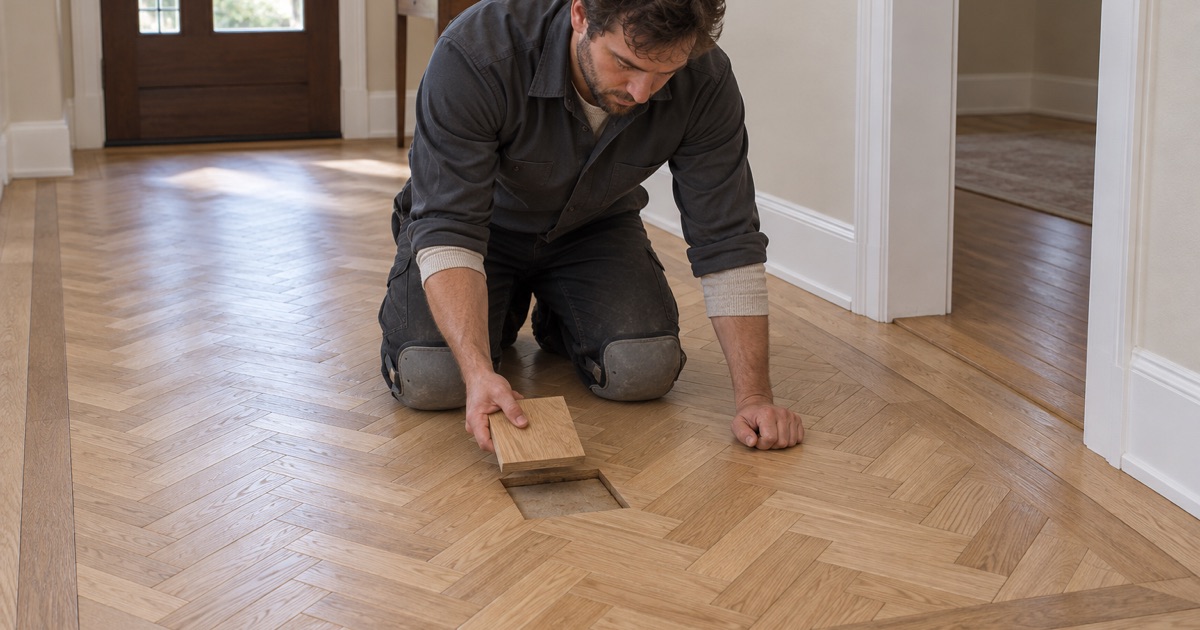
Where the block is intact and only the bond has failed, the tile is lifted, the old adhesive scraped off both surfaces, and the block re-set with an adhesive matched to the substrate. Done before sanding, the repair vanishes into the finished floor. Done after, or not at all, it becomes a chipped corner and a visible gap in a floor that has just been paid for.
Sourcing Matching Blocks for Missing Areas
Parquet patterns were never as standardized as strip flooring, and a discontinued block size or species is common. The reliable route is usually harvesting from somewhere the floor will not be seen — inside a closet, beneath an island going in, or under an appliance — and putting the salvaged material into the visible field. Where nothing matches, a deliberate contrasting border sometimes reads better than a bad approximation.
Finish, Color and Living With a Mid-Century Floor
Stain on a Multi-Directional Surface
Blocks facing different directions absorb stain at different rates, so a color that looks even on a sample board comes out variegated on parquet. That variation is the character of the material and most people want it, but it should be seen before it is committed to. We stain a test area of the actual floor and let you look at it in the room’s own light rather than describing what it will do.
Sheen, Wear and Keeping the Pattern Readable
A satin or matte finish generally suits parquet better than gloss, because the pattern already does the visual work and a high sheen flattens it into reflection. Matte also hides the micro-scratching that any entry-hall floor collects. Once refinished, a parquet floor benefits more than most from being kept on a recoat cycle, since each full sand takes thickness a thin block cannot spare twice.
- 20+ Years Experience
- Free Written Estimates
- Dust Containment on Every Sand