Burnsville Wood Flooring has installed, sanded and refinished wood flooring in Richfield for more than twenty years, and a good share of that work now arrives with a closing date already attached to it.
A purchase agreement is signed, the City has already been through the house, and a floor is sitting on a list of items that has to be cleared before the sale can complete. That is a different job from a floor a homeowner has been meaning to deal with someday. The scope is set by someone else, the standard is not ours to write, and the calendar is short.
So we quote it as what it is. The first visit is a measurement visit: moisture readings taken on the flooring and on the subfloor and compared against each other, the indoor relative humidity read on a hygrometer and written down, and a direct answer about whether the item can be corrected in place or whether boards have to come out. Everything downstream of that answer depends on it being right.
A certificate that has to be in hand before a closing
Richfield has worked this way since 1989. Under that ordinance, single-family and two-family homes, condominiums included, transferring title after October 1, 1990 have to be inspected by the City and a Certificate of Housing Maintenance Compliance obtained prior to the transfer of ownership or closing. Repairs needed to meet the housing code have to be completed and re-inspected prior to closing, and within one year of the initial inspection date.
The distinction that matters to a seller is that this is not a report the parties can read, price and move past. The certificate is a condition of the closing, and the corrections behind it are required work rather than negotiating material. A floor item on that list is a job with a date behind it.
Who does what, and what we do not do
The inspection belongs to the City of Richfield Inspection Division. We do not perform it, we do not issue the certificate, and nothing we write changes what an inspector records or accepts. What we can do is read the item, tell you what the underlying condition actually is, and correct it to a standard that holds up when someone looks at it a second time.
We say that plainly because the opposite gets promised in this market. Anyone implying they can get you the certificate is describing an authority they do not have, and a seller who believes it has planned a closing around it.
Reading the item before pricing it
Floor items on these lists are written in the language of the housing code, not the trade. Loose or springy flooring, a hole, a trip hazard, a finish worn through to bare wood: each of those has more than one cause, and the causes carry different prices and very different timelines.
So the first thing we do is separate the surface from the structure. A moisture meter on the boards and on the subfloor, a look at the fasteners where the movement is, and a check of whether the trouble sits in one bay or across a whole room. A number written before that is a guess, and a guess on a job with a closing behind it is expensive for everybody.
Looking for wood-flooring closer to Prior Lake? See Prior Lake Wood-Flooring.
What happens when the floor is the item that fails
Nearly everything we are called to correct on these lists falls into three groups, and which group it belongs to drives the price far more than the square footage does.
Movement, and where it comes from
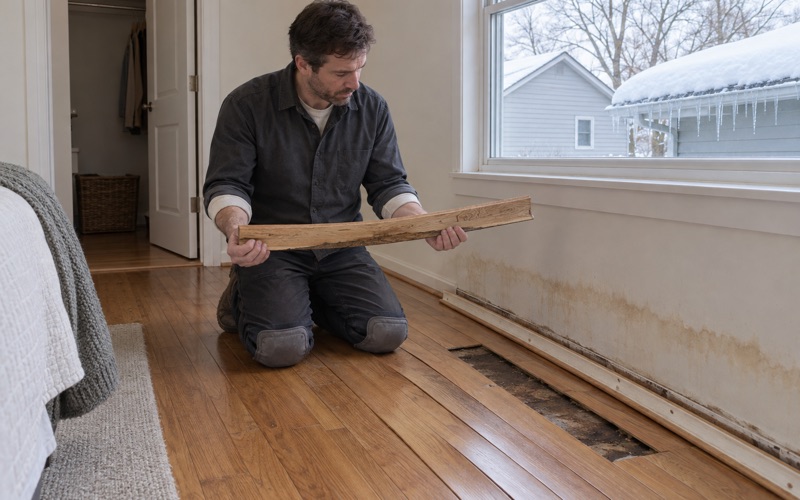
Loose boards, a springy bay, a run that has cupped across its width: these are moisture and fastening problems, not finish problems. Cupping means the underside of the board has taken on more moisture than the face, which puts the cause below the floor, in a supply line that wept, a dishwasher that ran for a season before anyone noticed, or an unsealed area underneath. Sanding a cupped floor flat while it is still wet produces crowning later, when the board finally equalizes and the edges drop below the middle. We measure the moisture content differential first and wait when the numbers say to wait, even on a short calendar, because the second failure belongs to nobody but us.
Wear, and what is left under it
A finish worn through to bare wood in a traffic lane is the easiest item on any list to see and one of the easiest to misprice. The question is not the finish, it is what remains of the board beneath it. On solid strip flooring we check tongue exposure at a register cut or a threshold to judge the thickness still available; on engineered flooring we measure the wear layer before quoting a refinish at all, because past a certain point there is nothing left to sand and the honest answer is replacement.
Holes, splits and damaged boards
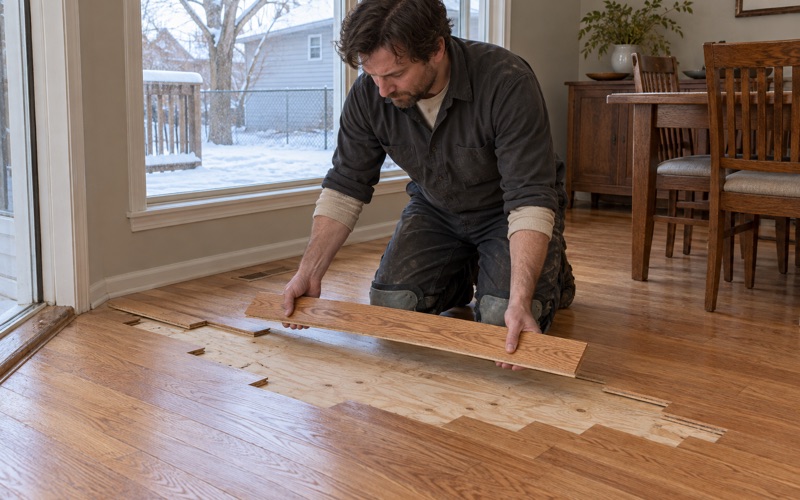
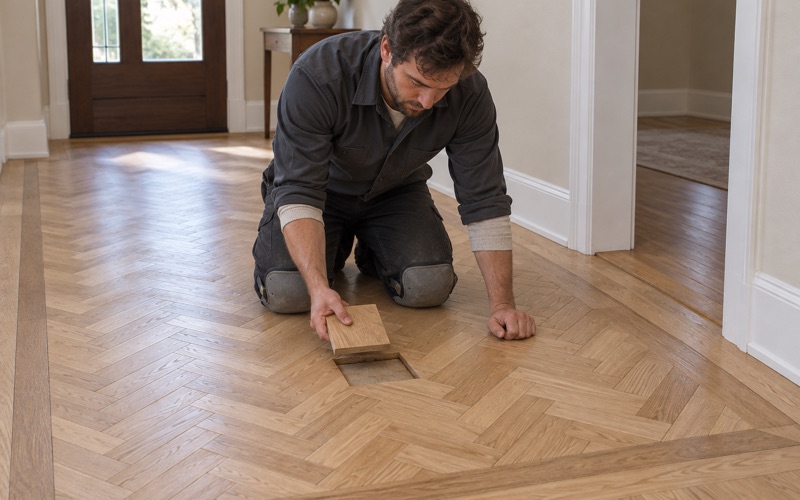
A single damaged area is often better handled as board replacement than as a full refinish. We weave in new boards so the end joints stagger into the existing field instead of terminating in a visible rectangle, and where the damage is small and the boards around it are sound, a dutchman patch is less disruptive than pulling a whole run. We will also tell you when a repair is going to show: new red oak set into a floor that has ambered for seventy years does not disappear without sanding the field, and that is better heard before the work than after.
Correcting the item and re-inspecting inside the window
The window is the part sellers tend to underestimate. Corrections have to be finished and re-inspected before the closing and within one year of the initial inspection date, which sounds generous until a sanding job is scheduled into it. Finish work is not a same-week trade in the middle of a Minnesota winter, and the finish itself sets much of the pace.
Dry time is not cure time
A waterborne polyurethane is dry enough to walk on in hours and is not cured for weeks. Oil-modified polyurethane is slower at both ends and carries its solvent smell through the house while it works. Those are two different answers to when a room can be crossed and when rugs and furniture can come back, so we put both dates in writing with the quote, alongside the grit sequence and the finish schedule, and the job can then be checked against something rather than described afterward.
Sequencing around the heating season
We sequence around the heating season instead of pretending it is not happening. Forced-air heat at full run pulls indoor relative humidity well below the thirty to fifty percent band a wood floor is specified for, which changes acclimation, board width at the moment of installation, and how a fresh finish behaves. Where a whole-house humidifier exists we ask that it be running before we start; where there is none, we say what the floor will do in January and what it will do again by June.
Permits, lead and dust
Interior finish work of this kind generally falls under the permit exemption at Minnesota Rules 1300.0120, which is not the same as being exempt from the housing code item behind it. Where the house predates 1978, sanding is lead-safe work under the EPA RRP rule and containment is planned before a machine is switched on. We run dust containment on every sanding job and give a straight answer about what it does not catch, because fine dust migrates and closets and cabinets are better closed and covered than cleaned afterward.
Not every floor we correct here is attached to a sale. Rental property in Richfield is licensed and inspected annually under Richfield City Code Section 407, renewals falling due by December 31 and the inspection covering the interior, exterior and common areas, which is a recurring cycle rather than a one-time clearance.
A 1950s floor and what is usually left of it
Richfield’s housing is concentrated in a single decade to an unusual degree. Of 17,183 housing units the 1950s are the largest build cohort at 31.1 percent, and 53.5 percent of the stock predates 1960. Owner occupancy runs at 61.6 percent, 10,186 of 16,547 occupied units, so most of these floors have been lived on by their owners rather than turned over on a rental cycle.
What that means underfoot is fairly consistent: nominal three-quarter-inch solid oak strip, mostly red oak, blind-nailed over a plank or plywood subfloor, and in a good number of houses still the original floor from the build. It is a floor worth keeping. It is also a floor that has usually been sanded at least once already.
How much sanding is left
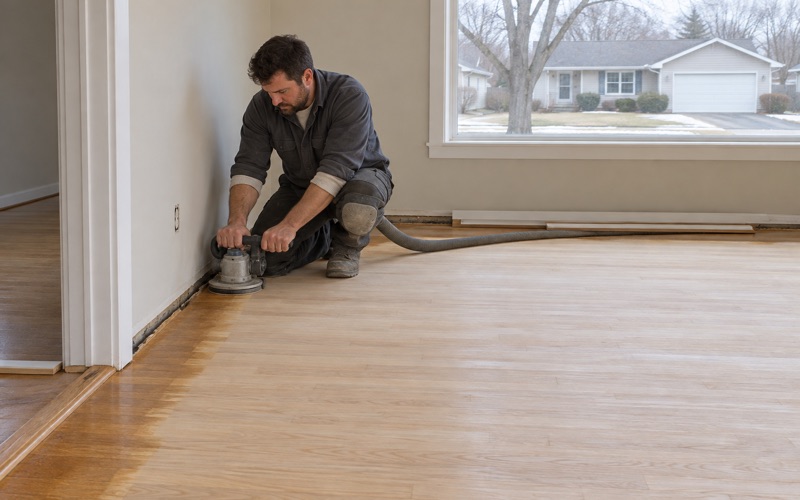
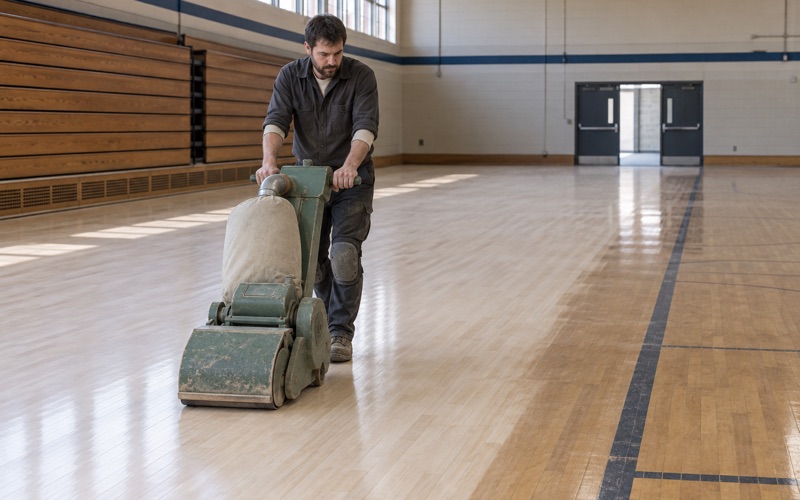
Every full sand takes thickness off, and the useful limit arrives when the tongue starts to appear at the board edges or a fastener head comes up under the drum. We look for the evidence of earlier work before quoting: scallop marks from a drum sander that was not kept moving, overwood at doorways where an edger could not reach, and dish-out along the walls. Where a floor has one sanding left in it we say so, and we say what that means for whoever owns it next rather than leaving it to be discovered.
Recoat when a recoat is the right answer
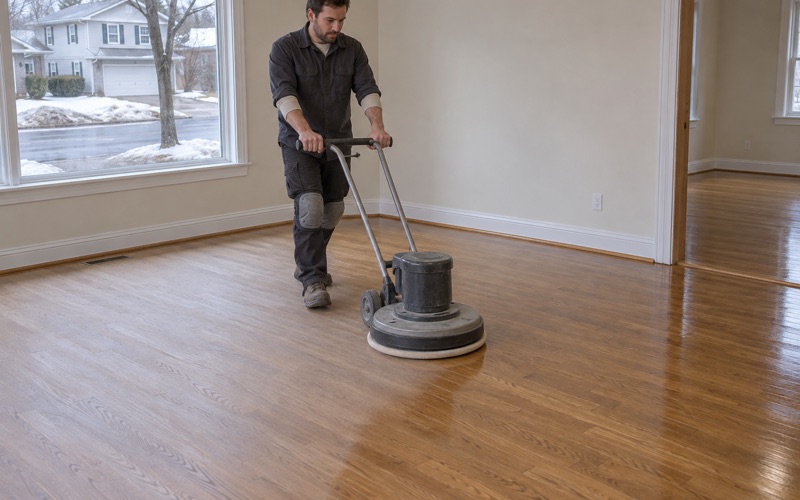
Where the finish is worn but not through and the boards themselves are sound, a screen-and-recoat is the correct job: an abrasive screen, a buffer and fresh coats over the existing finish, at a fraction of the cost and the disruption of a 36-50-80 grit sequence with a drum sander and an edger. We quote the two against each other honestly, including the cases where the cheaper one is what the floor actually needs. Where a bond test shows the old finish will not take a new coat, we say that as well, because a recoat peeling in a hallway is a worse outcome than the sanding it avoided.
Gapping in winter is not automatically a defect
Solid strip flooring in a heated Minnesota house gives up moisture all winter and the gaps between boards open. A good share of them close again by summer. We measure the gaps and the relative humidity in the same visit, write both down, and separate the seasonal movement from the part that is a genuine problem, because a buyer walking the house in February and a seller looking at the same floor in July are reading two different states of one floor.
The oldest wood floor in the city is not oak at all. The Riley Lucas Bartholomew House at 6901 Lyndale Avenue South, built in 1852 and added to the National Register of Historic Places in 1978, was put together from local lumber with white pine underfoot, and it survives as a museum. Ordinary houses get judged on a shorter horizon than that, but the principle is the same one we work to: a floor lasts as long as the moisture around it is understood, and no longer.
- 20+ Years Experience
- Free Written Estimates
- Dust Containment on Every Sand