
Burnsville Wood Flooring screens and recoats hardwood floors throughout Burnsville, MN and the south metro, and after 20+ years in this trade we quote it honestly against a full sand every single time. That includes the times the recoat is the right answer and the bigger invoice is not — a floor whose finish is worn but intact does not need the wood taken off it, and taking wood off a floor is the one thing nobody can undo.
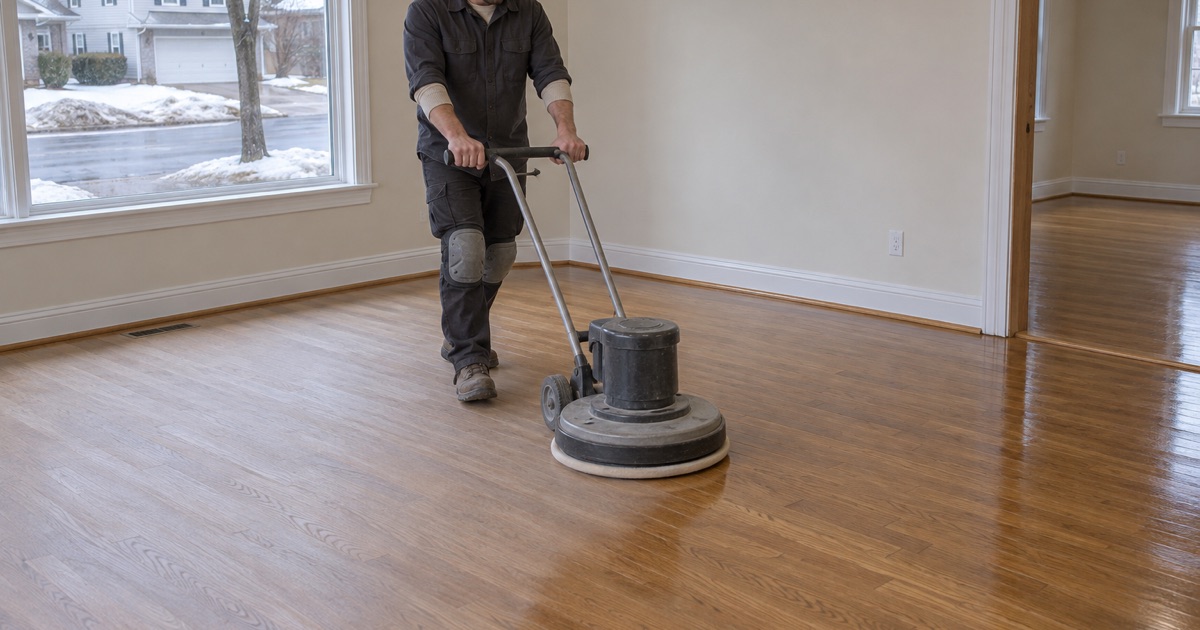
A screen-and-recoat abrades the existing finish with an abrasive screen on a buffer, cleans the floor thoroughly, and lays fresh topcoats over the top. Nothing is sanded to bare wood, no stain is changed, and the floor’s remaining sandable thickness is untouched. The result looks like a refinish from standing height and costs a fraction of one.
What it cannot do is fix anything living below the finish. That distinction is the whole conversation, and getting it wrong in either direction is expensive: recoating a floor that needed sanding buries the damage under a fresh gloss, while sanding a floor that only needed a recoat spends wood that will be wanted in fifteen years.
When a Recoat Is the Right Call
The Finish Is Worn, Not Worn Through
The deciding question is whether there is still a continuous film of finish everywhere on the floor. Where traffic has dulled, micro-scratched and hazed the surface but has not cut through it, an abrasion and two fresh coats restores the whole floor to something very close to new. The finish is the sacrificial layer; it is doing its job when it wears instead of the wood.
Nothing Has Reached the Wood Itself
A recoat sits on top, so anything already in the wood stays in the wood and is arguably easier to see afterward. Black pet staining, gray oxidized patches where the finish failed years ago, water rings that have penetrated, and deep gouges all fail this test. We walk the floor with you and point at the specific spots that will still be there, so the result is not a surprise.
What the Process Actually Involves
Abrasion With a Screen, Not a Sander
A buffer fitted with an abrasive screen scuffs the existing finish uniformly, creating the mechanical tooth a new coat needs to bond to. The edges and corners a buffer cannot reach are done by hand with the same abrasive, because a missed perimeter is where a recoat delaminates first. No drum sander is involved and no wood is removed, which is exactly the point.
Cleaning, Tack and the New Coats
The abrasion dust has to come off completely before finish goes down, and this is the step most often rushed. We vacuum, then tack the floor, then inspect it in raking light before opening a can. The topcoats go on to the manufacturer’s schedule, usually one or two depending on the product and the condition, with the recoat window respected rather than estimated.
Finish Compatibility Decides the Outcome
Testing Adhesion Before Committing to a Room
The failure mode that ruins a recoat is not wear, it is adhesion: new finish that never bonds and peels away in sheets a few months later. That happens when the new product is incompatible with the old one, or when something has contaminated the surface. We abrade and coat a test area first, let it cure, and check it, because finding out on a test patch is free and finding out on a whole floor is not.
What Has Been Used on the Floor Matters
Acrylic waxes, oil soaps and the various shine-restoring products sold for hardwood leave residues that finish will not stick to, and they cannot always be seen. This is the single most useful question we ask on a recoat estimate, and an honest answer saves everyone a great deal of trouble. Where a floor has been treated that way, cleaning or a full sand becomes the route rather than a recoat.
Recoating as Maintenance Rather Than Repair
The Cycle That Saves the Wood
A floor recoated on a regular cycle, before the finish is breached, can last generations without a full sand. Each full refinish spends a measurable amount of the wood above the tongue and there is a finite supply of it. Recoating spends none, which makes it the cheapest and least destructive thing you can do for a hardwood floor over its life.
Sheen, Traffic and Timing the Job
A recoat is the natural moment to change sheen, since the topcoat is what carries it — a matte or satin finish hides dust and micro-scratching far better than gloss in a busy household. Timing matters less than for a refinish, but the same Minnesota logic applies: waterborne coats cure faster in a warm, running house, and January is not the month for open windows.
- 20+ Years Experience
- Free Written Estimates
- Dust Containment on Every Sand