Burnsville Wood Flooring has been sanding, finishing and installing wood flooring in South St. Paul for more than twenty years, and the age of the paint in a room shapes almost every job we quote here. A floor sander does not only cut wood, it cuts whatever is bonded to the wood and whatever sits along the line where the floor meets the trim. That distinction separates an ordinary refinish from a regulated renovation, and here it comes up constantly.
That is why our estimates in this city start with the year the house went up rather than with the species underfoot. We want to know what is beneath the carpet, what the baseboards have been coated with over the decades, and whether the floor has already been sanded once before. Those answers change the containment plan, the sequence and the price, and we would rather have them before the quote than after the drum sander is in the hallway.
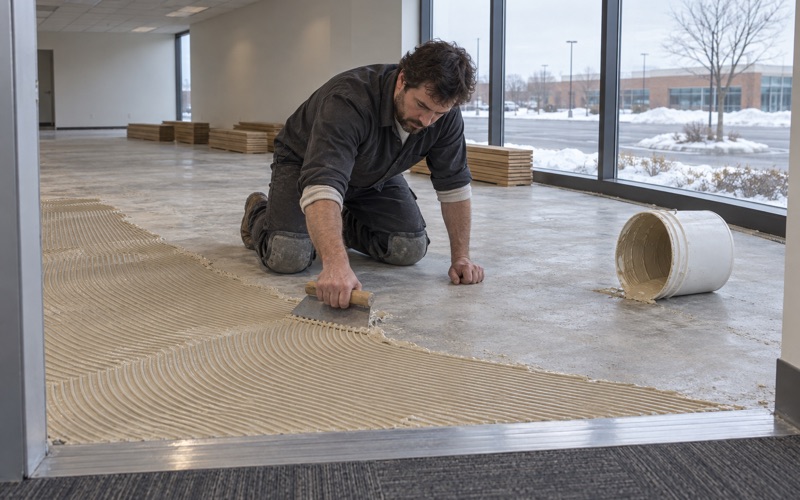
Two other things get written down on that first visit. We read the indoor relative humidity with a hygrometer and record it, because wood flooring is specified for a band that most heated houses in this state fall out of by January, and we check the moisture content of the flooring against the moisture content of the subfloor before a single board is fastened down.
Where the federal lead rule is the default, not the exception
The federal EPA Renovation, Repair and Painting rule governs work that disturbs painted surfaces in housing built before 1978, and in South St. Paul that description covers the ordinary house rather than the unusual one. Of the city’s 8,639 housing units, 55.1 percent predate 1960 and 22.6 percent predate 1940, while 77.1 percent went up before 1980 and only 12.2 percent were built in 2000 or later.
Contractors working in newer suburbs treat the pre-1978 question as a screening step that usually comes back negative. We treat it as the baseline assumption and work backward from there, because the odds in this housing stock run the other way.
The rule is federal, and that is not a technicality
Minnesota is not an EPA-authorized state for this program, so the requirement sits with the federal government and the EPA is the agency behind it. Homeowners sometimes go looking for a Minnesota version of the requirement, find nothing, and conclude the whole subject is optional. The obligation is real either way, and it attaches to the firm doing the disturbing rather than to the person living in the house.
Which wood floor jobs actually disturb paint
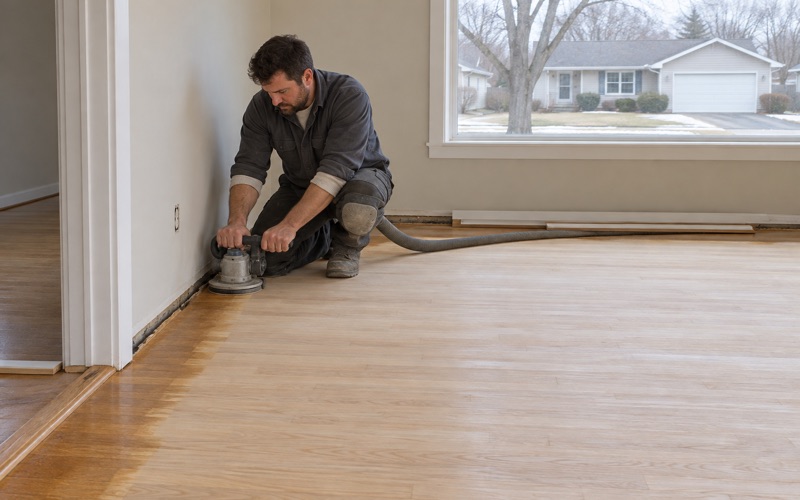
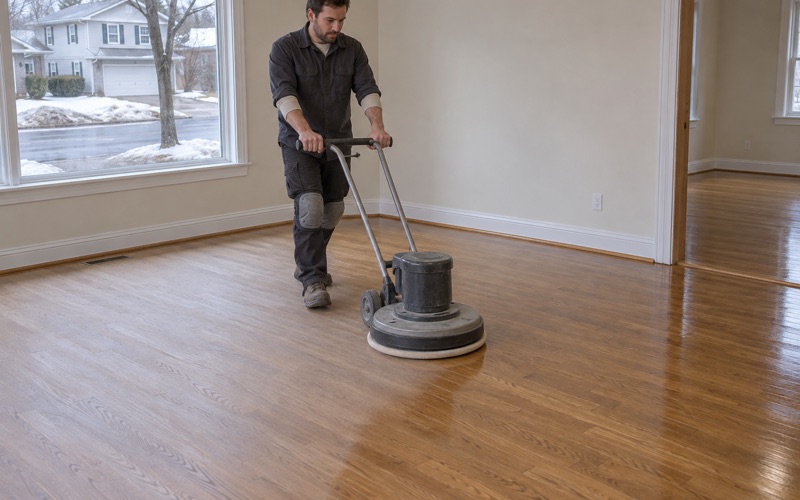
Not every job does. A screen-and-recoat abrades only the existing finish film in the field of the room, and a nail-down installation over a sound subfloor can often be completed without a tool ever reaching a painted surface. A full sand-and-refinish is the opposite case, because the edger and the hand scraper have to work right up against the base shoe, and the paint on that trim is exactly where the contact happens.
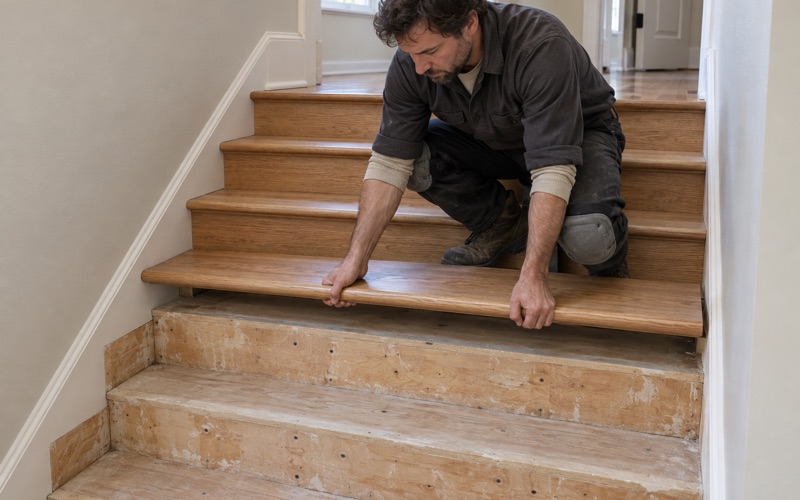
Pulling the base shoe off to get a clean edge disturbs paint by definition, and so does scraping a closet threshold or a stair nosing that has been painted over. We sort a job into one of those categories during the estimate rather than during the work. It is the largest single swing in what the project costs and in how many days the house is unusable.
Looking for wood-flooring closer to St. Paul Park? See Wood-Flooring Services in St. Paul Park.
What lead-safe work practice changes about a sanding job
The practices themselves are not exotic, but they reorder the job. Plastic sheeting goes up before the machines come in, the work area is closed off from the rest of the house, and the doorways and floor registers are sealed rather than merely covered. Anything that would spread dust by moving air gets shut down for the duration, which on most of these houses means the forced-air furnace.
Open flame and high-heat methods are off the table on painted trim, so anything that has to come off comes off cold and slowly. Debris is collected as it is generated instead of at the end of the day. None of that is difficult work, but all of it takes hours that a quote written for a newer house does not contain.
No permit, and no exemption from anything else
Refinishing an existing floor is finish work, and Minnesota Rules 1300.0120 subpart 4 exempts painting, papering, tiling, carpeting, cabinets, countertops and similar finish work from the permit requirement. That same subpart states plainly that an exemption does not authorize work performed in violation of the code or of other ordinances. Homeowners occasionally read the first half of that as permission to skip everything, and it is worth saying out loud that the two are unrelated.
Living in the house while it happens
A contained sanding job is harder to live around than an uncontained one, which surprises people. Rooms come out of service in a defined order, the plastic stays up between phases rather than coming down each evening, and the finish schedule has to respect cure time rather than dry time. We sequence the work around the heating season instead of pretending the season is not there, and we say at the estimate which nights the house is comfortable to sleep in.
Scheduling against a closing date
Owners planning to sell should know that the city runs a time-of-sale housing inspection program under City Code Chapter 106, Article VI, sections 106-178 through 106-185, and that any item the evaluation report marks hazardous has to be corrected before the buyer takes possession. A worn floor is not normally what a report flags, but the timeline it imposes is real, and a refinish booked around a closing has to leave room for the finish to harden rather than merely to dry. We would rather build that into the sequence at the estimate than discover it in week two.
Containment, cleanup, and the dust it does not catch
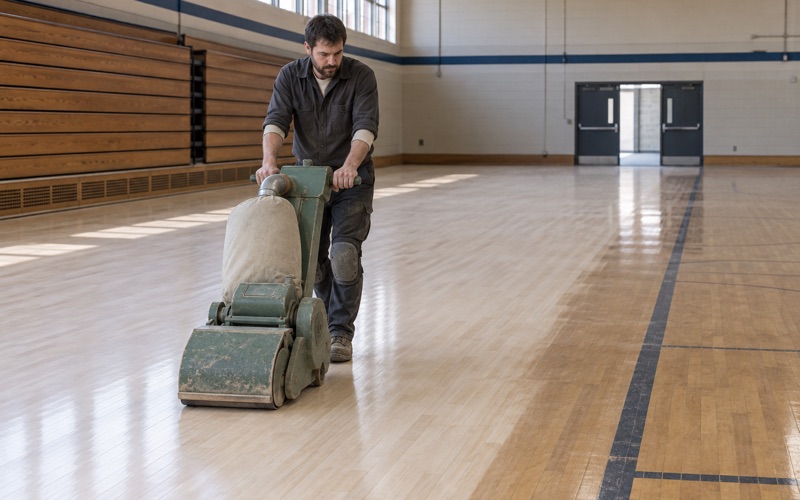
Every sanding job we run has dust containment on it, and every customer gets a straight answer about what containment does not do. A drum sander and an edger connected to a vacuum system pull the great majority of what they generate straight into a bag or a cyclone. The fraction that escapes is the fine fraction, and fine is the part that stays airborne longest and settles furthest from the machine.
On a pre-1978 floor that fine fraction is the whole reason the containment exists. It is also why the cleanup at the end is not a broom and a shop vacuum, but a sequence of wet wiping and vacuuming repeated on the horizontal surfaces until a wipe comes back clean. Verifying the cleaning is a step in its own right, not a glance around the room.
What still gets through
Containment is a boundary, and boundaries leak at the seams. Duct runs cut through old plaster, a laundry chute nobody remembers, a gap behind a radiator pipe: these are the paths dust takes in an older house, and none of them appear on a floor plan. We look for them before the plastic goes up, and we tell people where we expect to find dust afterward rather than promising there will be none.
Written down, so it can be checked
The quote we hand over carries a written grit sequence and a finish schedule, so the finished floor can be measured against something specific rather than against a memory of a conversation. A 36-50-80 grit sequence on a solid strip floor means something, and skipping a step in it shows up as swirl under a low sheen level. The containment and cleanup plan is written the same way, and the crew on the final coat is the crew that was there on the first day.
Original narrow strip hardwood under later floor coverings
A large share of the sanding we do in South St. Paul is on floors that were covered up decades ago and forgotten. Narrow strip hardwood was the standard floor in the houses that went up around the stockyards, and carpet, sheet vinyl and glued-down tile went over the top of it in later remodels. Pulling that covering is the first honest look anyone has had at the wood in a long time.
Why the stock looks the way it does
The city was incorporated in 1887 and built out around the Saint Paul Union Stockyards, whose two largest employers at their peak were Swift and Company and Armour Meats. Many families here descend from Southern European and Eastern European immigrants who came for the packing plant work in the early twentieth century, and the housing went up to hold them. The stockyards closed around 2008, but the floors those wages paid for are still in the houses.
What is left above the tongue
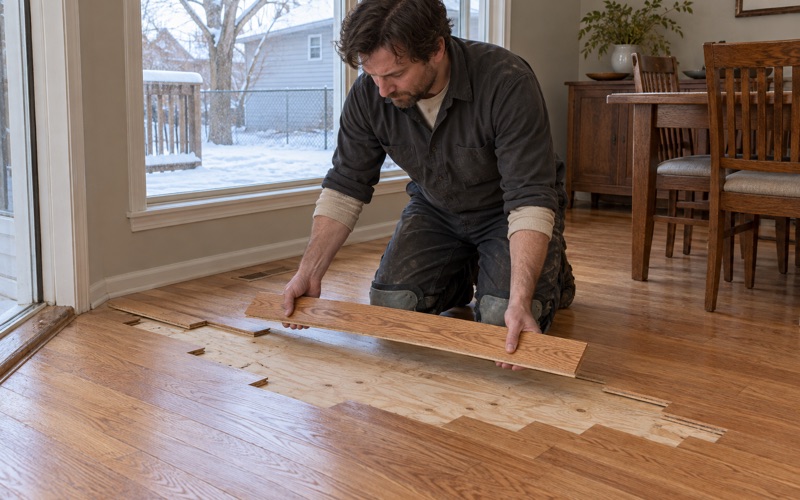
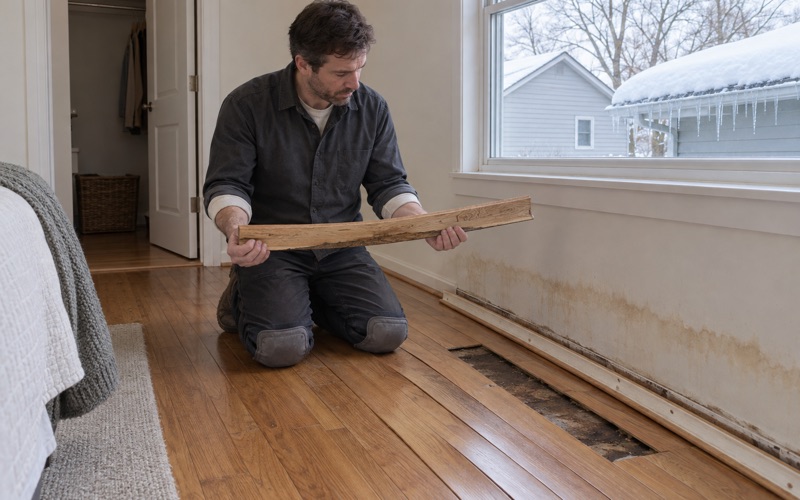
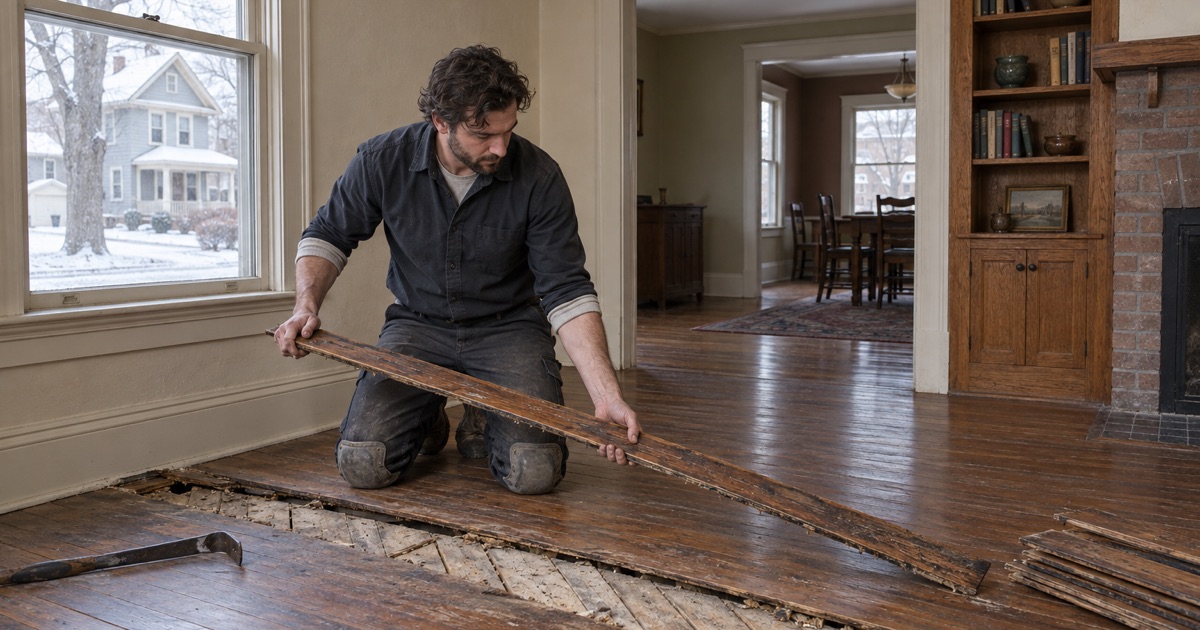
Tack strip holes along the perimeter, staple holes across the field, and adhesive residue that has to be scraped rather than sanded are the usual conditions. Boards that have been wet at a doorway or under a radiator get replaced individually, woven into the surrounding courses so the seams disappear under finish, and a badly damaged area sometimes takes a dutchman patch instead. What we are measuring on the first pass is how much wood is left above the tongue, because a floor that has already been sanded twice may not have a third pass in it.
On engineered flooring the same question is a wear layer measurement, and we take it before quoting a refinish rather than after the drum has been through a board. Past a certain thickness there is nothing left to sand, and the honest answer is a recoat or a replacement. We quote a screen-and-recoat against a full sand-and-refinish on its merits, including the jobs where the cheaper one is the right one.
Moisture on a floor that has been covered for decades
Wood that has spent decades under carpet in a heated house has reached its own equilibrium moisture content, and uncovering it changes the conditions it lives in. We meter the boards and the subfloor and compare the two readings before any new material is fastened alongside them, because a moisture content differential is what produces cupping in the spring and dry cupping over a warm register in the winter. Seasonal gapping gets measured and explained before anyone calls it a defect, since a good share of it closes again by June.
- 20+ Years Experience
- Free Written Estimates
- Dust Containment on Every Sand