Burnsville Wood Flooring has been installing and refinishing wood flooring in Uptown for more than twenty years, and most of that work happens on floors laid long before anyone living on them today was born. The strip oak under a Hennepin Avenue apartment or a Wedge duplex has almost always been sanded at least once, sometimes three times, and what is left of it decides what anyone can honestly quote. So the first visit is a measuring visit rather than a sales call.
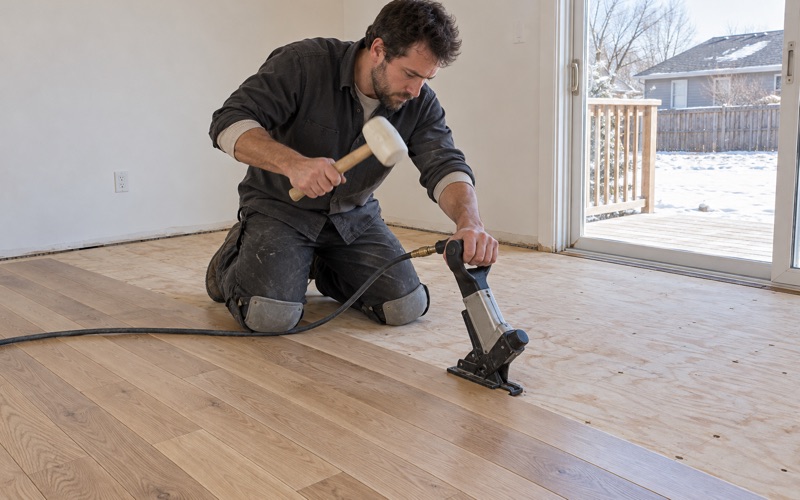
We read indoor relative humidity and write the number down before we talk about products, because a wood floor is specified for a band that most heated Minnesota buildings fall out of every January. We check the moisture content of the flooring against the moisture content of the subfloor, with a moisture meter, before a single board goes down rather than after somebody calls about gaps.
The quote leaves with a written grit sequence and a finish schedule attached, so the finished job can be checked against something other than memory. The crew that walks the rooms with you at the estimate is the crew that lays the last coat. In a building where the work has to be scheduled around other people’s front doors, that continuity does more than it sounds like it should.
The blocks a streetcar line built
Uptown is not one of the eighty-three residential neighborhoods the City of Minneapolis recognizes. It is a commercial district with no official boundary, generally centered on the intersection of Hennepin Avenue and West Lake Street, and it has traditionally spanned the corners of four neighborhoods: Lowry Hill East, East Isles, South Uptown and East Bde Maka Ska. All four sit inside the Calhoun Isles community, and when somebody books an estimate for Uptown our first question is which block, because the block tells us what the floor is likely to be.
Lowry Hill East, known to nearly everyone who lives there as The Wedge, developed in the 1880s along a horse-drawn streetcar line built by Thomas Lowry. It runs from Lyndale Avenue on the east to Hennepin Avenue on the west, with Lake Street as its southern edge, and its interior holds large early twentieth-century houses standing beside multi-unit apartment buildings. Housing put up for people who would walk to a streetcar sits close together, and it went up in a period with its own settled way of laying a floor.
A majority built in 1939 or earlier
In census tract 1067, which covers residential blocks on the Lyndale side of the commercial core, 1,734 of 3,236 housing units, or 53.6 percent, were built in 1939 or earlier. In census tract 1080, on the Hennepin side, 1,240 of 2,391 units, or 51.9 percent, date to the same period. Those two tracts are not the district itself, which has no official line anyone can draw; they cover the residential blocks flanking it and approximate it closely enough to plan around.
What that age already did to the floor
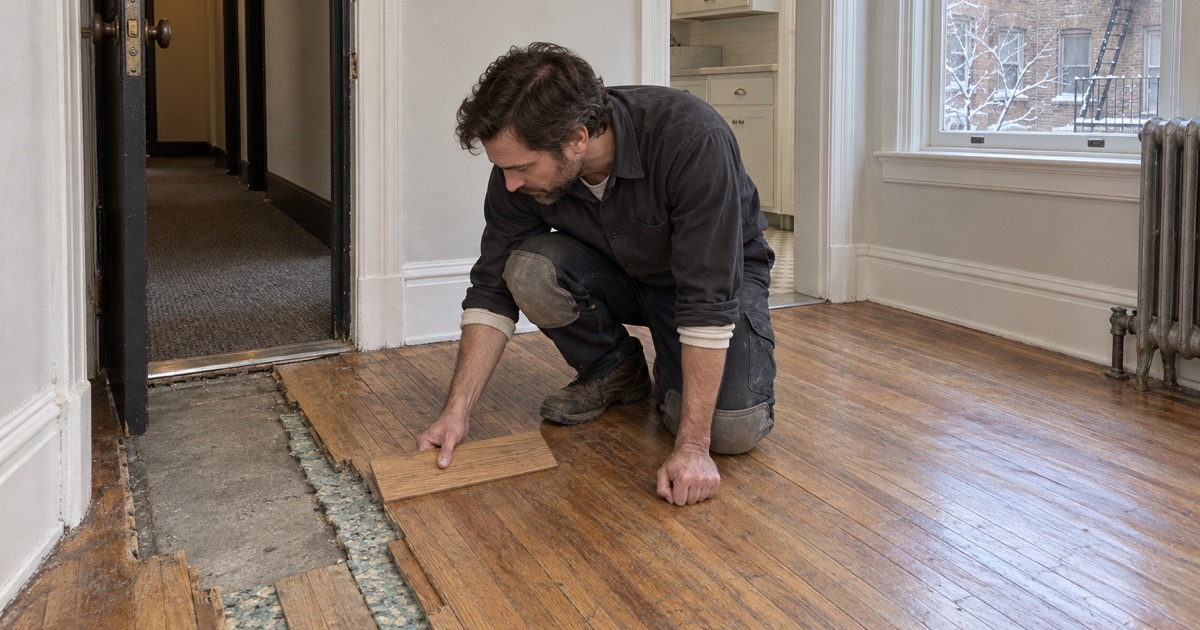
Floors from that build-out are usually narrow strip oak, commonly a little over two inches across the face, red oak more often than white, with hard maple turning up in kitchens and back stairs. They were site-finished, and by now most have been sanded at least once. The previous sanding is what we hunt for on the first visit: lathe checks opening in the grain, a sand-through at a doorway where a drum was set down hard, overwood where a board was swapped in and never leveled.
Pre-1978 housing and the lead rule
Stock this old is pre-1978 housing, so renovation that disturbs paint in it falls under the federal Renovation, Repair and Painting rule. Minnesota is not on the EPA list of authorized states, which means the EPA administers that program here directly and firm and renovator certification is federal rather than state. Floor work runs an edger along painted baseboards and a scraper into painted corners, so how a contractor handles that rule is a fair question to put to anyone quoting the job.
Looking for wood-flooring closer to Whittier? See Wood-Flooring in Whittier.
Narrow strip oak, and how much of it is left
Measuring before quoting
On engineered flooring we measure the wear layer before quoting a refinish, because past a certain thinness there is nothing left to sand and a quote that ignores it is a quote to ruin a floor. On solid strip we read how far the surface has dropped at the perimeter of each room, where the edger has done its work in every refinish the floor has already had. Both readings go in writing. They separate a floor with one more sand in it from a floor that needs a different plan entirely.
Screen-and-recoat against a full sand
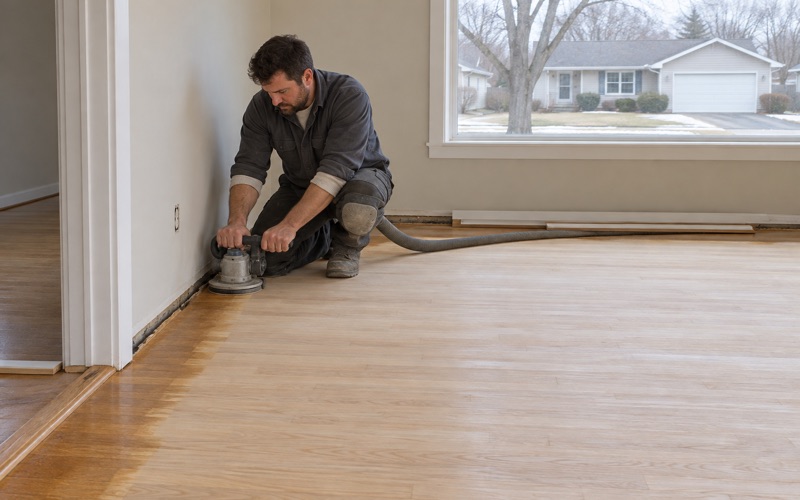
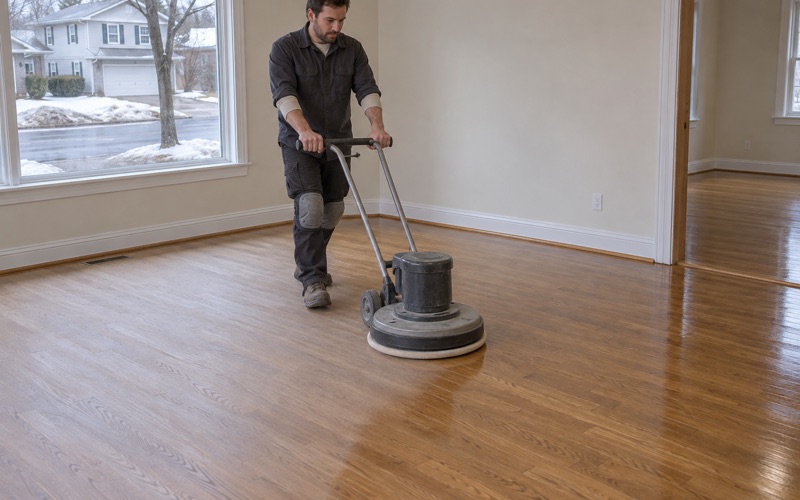
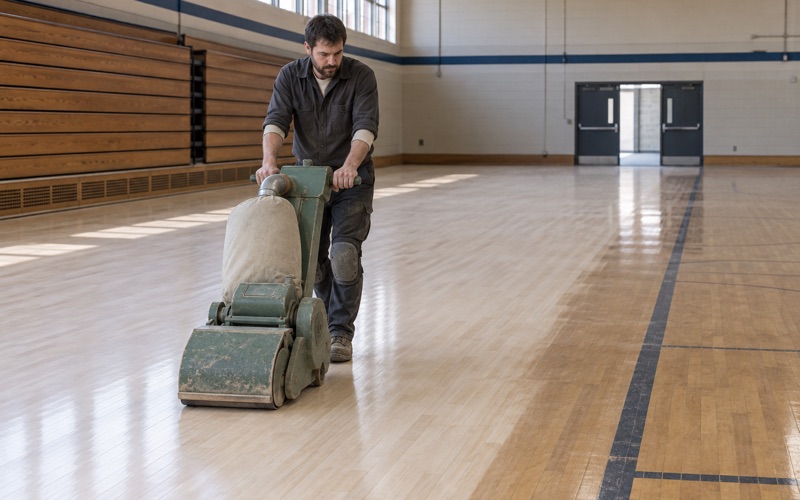
A screen-and-recoat abrades the existing coating with an abrasive screen on a buffer and lays fresh finish over it, and on a floor whose finish is worn but not worn through it is the right job. A full sand-and-refinish takes everything back to raw wood through a grit sequence, 36-50-80 being the usual one on old strip oak, with a drum sander in the field, an edger at the walls and a buffer to blend the two. We price both against each other and say which we would choose, including the times the cheaper one is the answer. The finish schedule names the sealer, the number of coats, the sheen level and the gap between dry time and cure time.
Board replacement, weave-in and patches
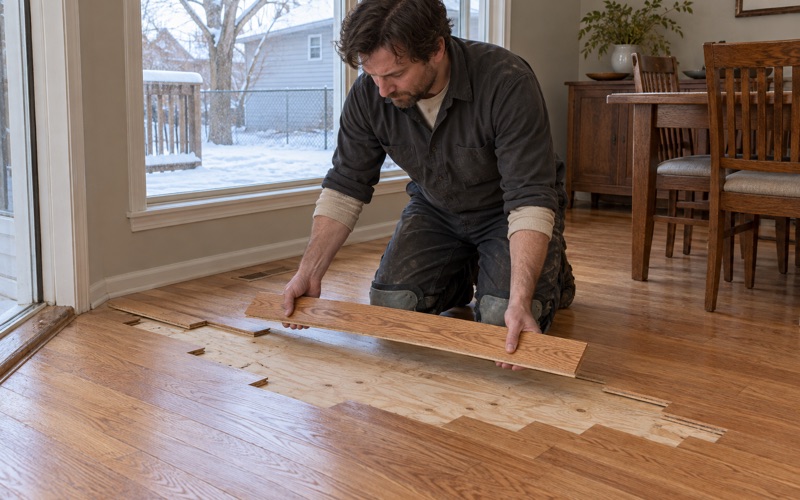
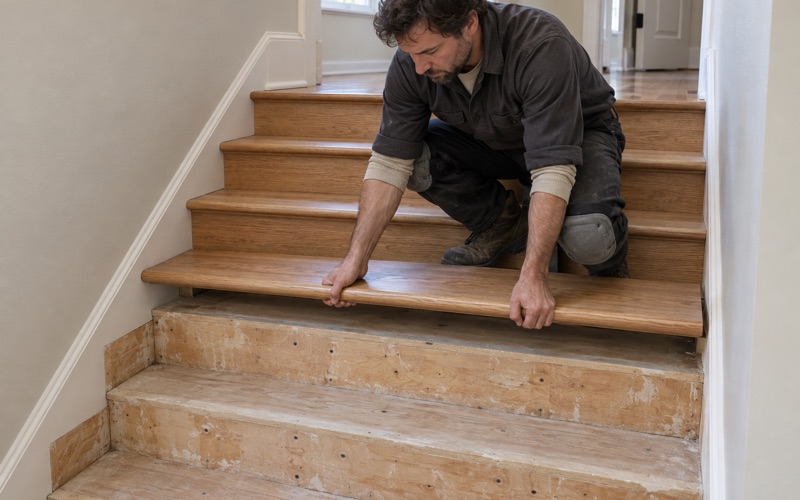
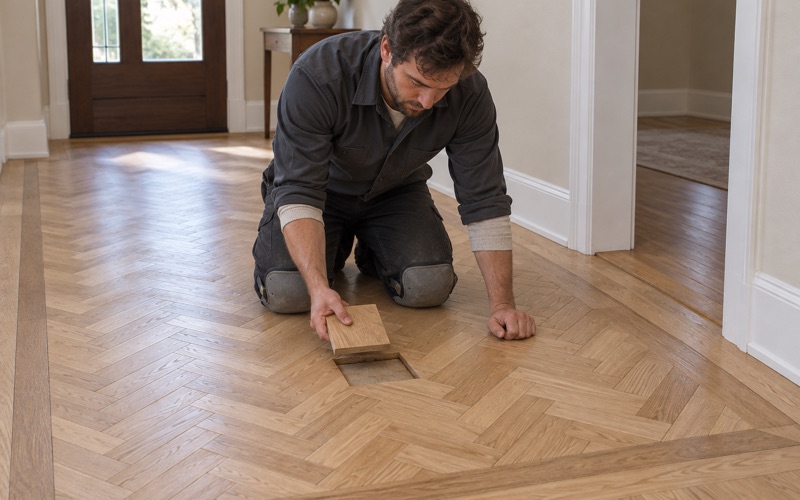
Old buildings have had radiators moved, walls opened and closets framed in, and the floor keeps the record of all of it. Where boards have to come out we weave replacements into the existing courses rather than dropping a square patch into the middle of a room, and where a weave-in cannot work a dutchman patch cut to follow the grain is the honest fix. Matching is the hard part: red oak and white oak take stain differently, and quartersawn material set next to plainsawn reads as a repair from across the room even when the species is right.
Working in an occupied building with neighbors either side
Most of the housing on the residential blocks either side of the commercial core is rented. In tract 1067, 314 of 3,071 occupied units, or 10.2 percent, are owner-occupied; in tract 1080 the share is 631 of 2,220, or 28.4 percent. Most of our work in these blocks therefore happens in a building somebody else also lives in, on a schedule that has to survive contact with a landlord, a board, or the neighbor one ceiling down.
Rental licensing sets a floor standard
Every rental dwelling in Minneapolis has to be licensed by the city, and the maintenance standard in chapter 244 of the Code of Ordinances requires interior floors to be kept in a professional state of repair, structurally sound, without holes and without trip hazards. For an owner renting a unit out, a lifted board or a failed patch stops being a cosmetic question. We write repair scopes against that language so the work and the requirement describe the same floor.
Approvals before the first machine comes in
Association and board paperwork gets settled before an upstairs job starts, not halfway through it, because a job stopped on day two is a floor left open in somebody’s home. Buildings under a common interest ownership association often set sound requirements in their rules as an impact insulation class or sound transmission class figure, with a rating of 45 showing up frequently, and those are measured by ASTM E492 and ASTM E90. Where a number is written into the rules the underlayment is part of the specification, not something picked off the truck.
Dust, coatings and the hours people are home
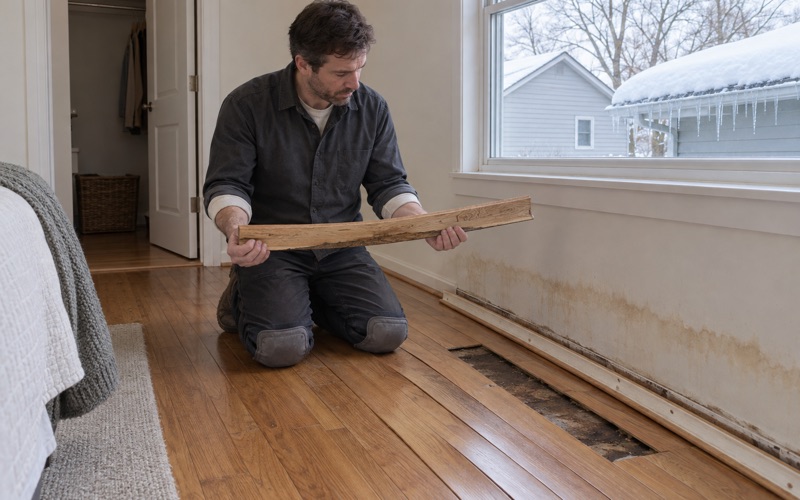
We run dust containment on every sanding job and tell you plainly what it does not catch, because nothing on the market catches all of it. Coating schedules get planned around the hours a unit is actually occupied, and waterborne polyurethane earns its place in these buildings for the time it takes between coats more than for anything printed on the can. When water has come through from the unit above, we photograph and document the floor for the claim before anything is torn out, because like kind and quality is argued from evidence and the evidence usually goes into the dumpster first.
What a Truth in Sale of Housing evaluation says about a floor
Minneapolis requires a Truth in Sale of Housing evaluation on single-family houses, duplexes, townhouses and first-time condominium conversions. A Minneapolis-licensed evaluator has to complete it within three days of the property being offered for sale, and before it is shown. The report stands for two years or one sale, whichever comes first, so the timing of floor work around a listing is worth thinking through before the sign goes in the yard.
Floor condition is one of the items
Floor condition is among the items the evaluator covers, which is why a good share of our calls in these blocks arrive in the weeks before a property is listed. What the evaluation does not do is look at lead-based paint; that sits outside the evaluator’s checklist entirely, and a seller who treats the report as having settled it has been told something the program does not say. On a building of this age the two questions are separate, and both are worth answering.
Deciding what is worth doing before a sale
A recoat ahead of a listing can make a tired floor read as maintained, while a full refinish can be the wrong spend on boards the next owner will cover with rugs inside a month. We quote both, we say which one we would pick, and we put cure time in writing so nobody drags furniture back onto a floor that is dry but not yet hard. The estimate, the sanding and the final coat all come from the same crew, which is how the finish schedule stays a promise rather than a document.
The historic designation is about the outside
Minneapolis local historic designation applies to exterior features. Where a building carries one, it governs what the street sees, and the oak in the front room is not part of that conversation. What does govern the floor is the air inside the building, which is why the humidity reading happens on the first visit and gets written down. Heated buildings here spend January well under the band a wood floor is specified for, and gapping measured in February that has closed again by June is a season rather than a defect.
- 20+ Years Experience
- Free Written Estimates
- Dust Containment on Every Sand