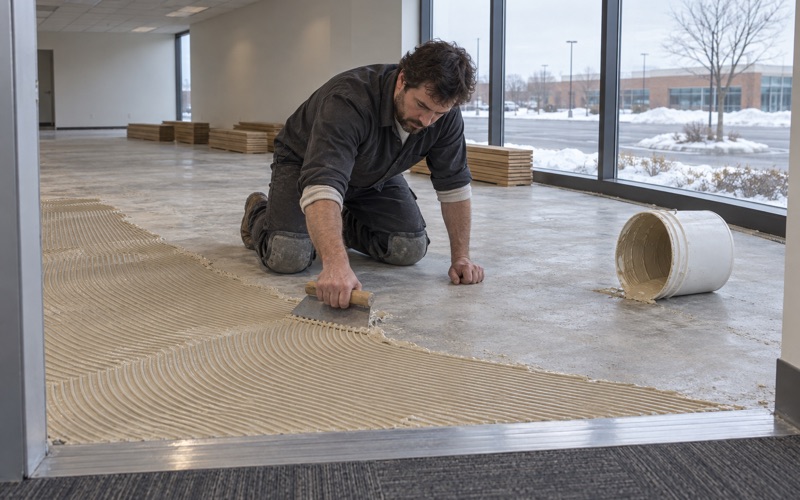
Burnsville Wood Flooring has spent more than twenty years installing, sanding and refinishing wood flooring in Waconia, and the job here comes with conditions we plan for rather than react to. Houses in this part of Carver County spend half the year sealed up and heated and the other half open to lake air, and a wood floor registers both halves.
Most of the work itself is ordinary: nail-down installation over a plywood subfloor, a screen-and-recoat on a finish that has dulled without wearing through, a full sand and refinish on one that has. What changes from town to town is the building stock, who has to sign off before tenants move in, and how the house is actually used across twelve months. Waconia hands us all three at once.
So a first visit here is mostly measuring and writing things down. We take an indoor relative humidity reading and record it, we meter the flooring and the subfloor separately rather than together, and we leave with numbers instead of an impression.
A free-standing town with its own schedule
Waconia does not run on somebody else’s main street. The city has its own downtown, its own school district in Waconia Public Schools, which operates five schools serving kindergarten through grade twelve, and its own hospital.
Ridgeview Medical Center is an independent 109-bed acute care hospital on Highway 5, and Ridgeview reports more than 1,900 employees and 485 volunteers. That reaches our scheduling: shift work keeps houses occupied at odd hours, and a finish has to cure in the hours a house is empty.
Population was 13,033 at the 2020 Census, up from 6,814 in 2000, and the housing stock followed. More than half of the city’s 5,291 housing units, 53.4 percent, went up in 2000 or later.
The 2000s are the largest single build decade at 32.7 percent, which puts a great many Waconia floors somewhere between fifteen and twenty-five years old. That is the age at which a factory-applied finish stops being a finish and becomes a wear surface with holes in it.
The recoat question on a twenty-year-old floor
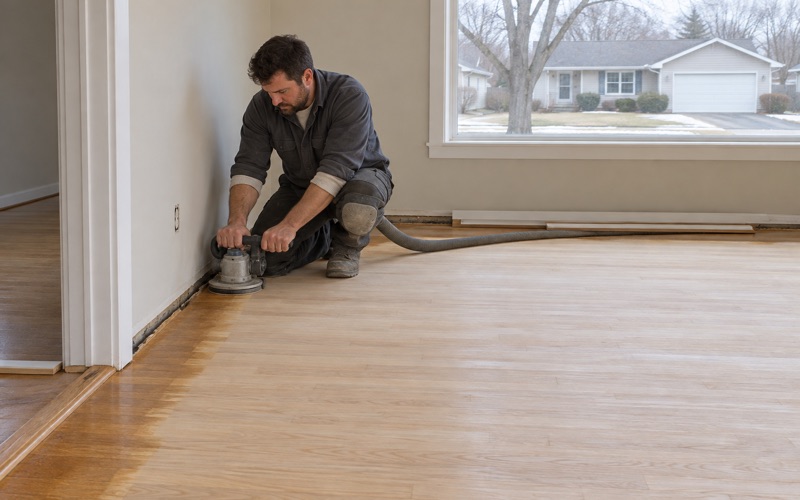
On a floor that age we measure before we quote. If the finish is worn but the wood underneath has not been scratched gray, an abrasive screen and a fresh coat of waterborne polyurethane cost a fraction of a full sand, and we say so even though the screen-and-recoat is the smaller job.
Where the floor is engineered rather than solid, the wear layer gets measured first. Engineered core construction varies enormously between products, and past a certain remaining thickness there is nothing left to sand, so quoting a refinish on that floor would be selling something that cannot be delivered.
Floors that have not seen a winter yet
A floor going into a house finishing up in autumn has not lived through a heating season. We check the moisture content of the boards against the moisture content of the subfloor before any of it goes down, because a moisture content differential that looks harmless in a warm, unfinished house turns into cupping in February.
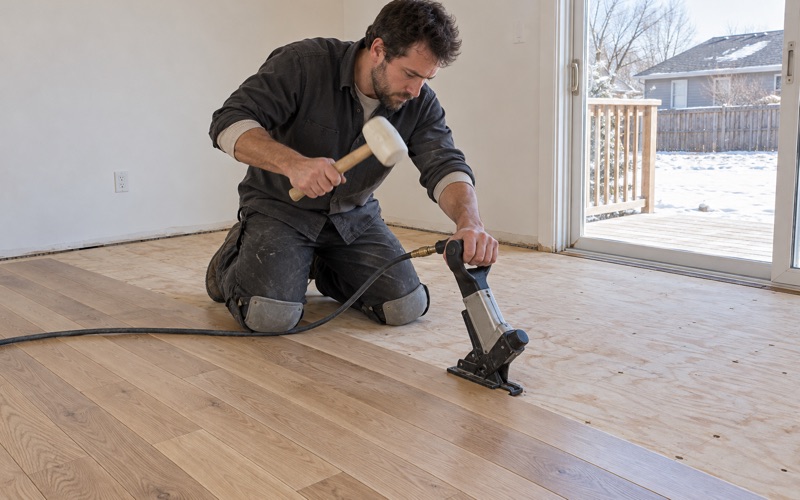
We also sequence work around the heating season instead of pretending it is not there. A January install in a house on forced-air heating with no whole-house humidifier puts every board down at its narrowest width of the year, and the NWFA installation guidelines on expansion gap and fastener spacing exist for that reason.
Looking for wood-flooring closer to Stillwater? See Wood-Flooring Services in Stillwater.
Resort-era buildings and the boards inside them
Waconia grew up around a lakeshore resort economy that drew tourists from 1884 until the late 1920s, when the rise of the automobile let people vacation farther from home. What that era left behind is a narrow, specific slice of the housing stock: lodging houses, guest cottages and the year-round dwellings built to serve them.
Coney Island of the West, a thirty-one-acre island in Lake Waconia about half a mile off the city’s shore, was the center of it. Through a heyday running from the 1880s to the 1920s it carried hotels, a boarding house, private cottages, a bowling alley and a pavilion, and Carver County has developed the island as part of Lake Waconia Regional Park since 2016.
Only 5.2 percent of the city’s housing units predate 1940, which is a couple of hundred buildings and no more. They sit scattered across the town rather than gathered into one area, and we meet them one at a time.
Widen the window to 1960 and the share reaches 9.5 percent. That is still a minority of Waconia, but it is a real number of floors laid before plywood subfloors were the default.
What an old floor here actually needs
On those buildings the work is repair before it is refinishing. The flooring in that stock is usually narrow-strip red oak or hard maple, blind-nailed over a plank subfloor and thinner than it looks. Lathe checks from the original slicing, a century of traffic and one or two previous sandings can leave very little wood above the tongue, so we measure what is left before choosing a grit sequence.
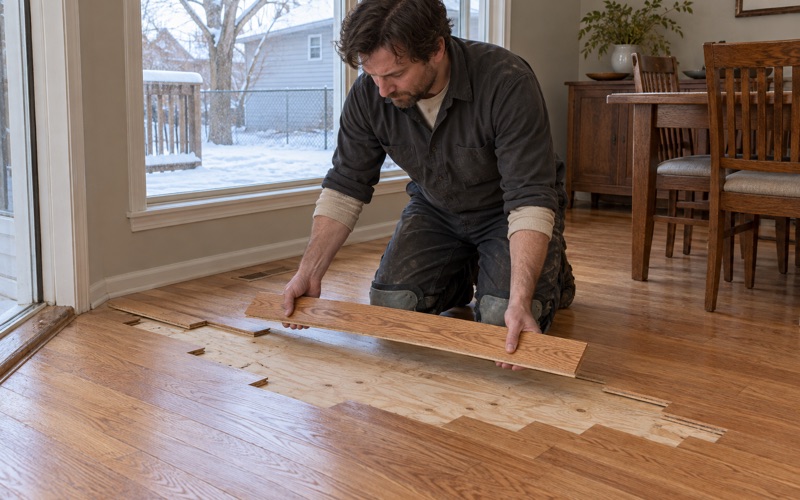
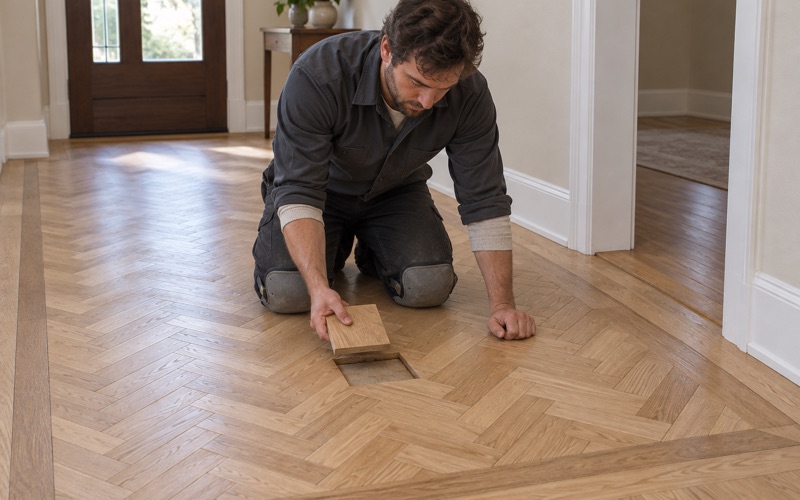
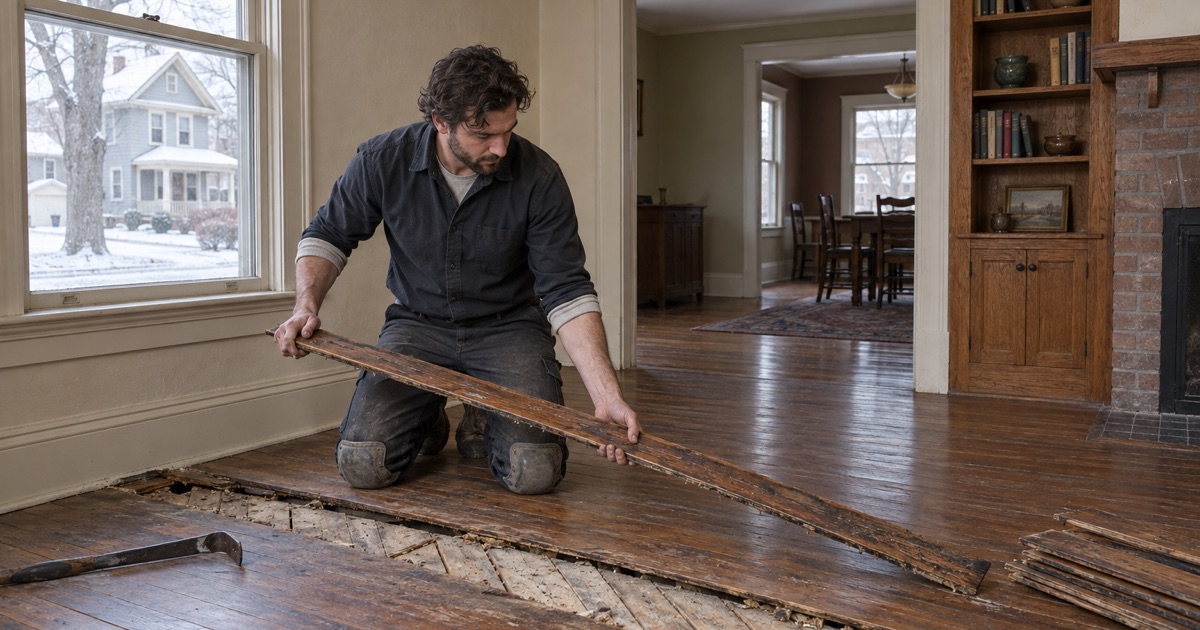
Where boards are broken or missing we weave replacements into the field rather than dropping in a patch that reads as a patch. A weave-in or a dutchman cut to follow the surrounding grain disappears under finish, and a rectangle of new oak set into old oak never quite does.
On a thin floor we run a conservative 36-50-80 grit sequence and accept that some character stays in it. Chasing every stain with a drum sander on a floor with a sixteenth of an inch left is how a sand-through happens, and no amount of further sanding repairs one.
Lead and dust in the older stock
Any house built before 1978 falls under the EPA RRP lead-safe rule, and sanding is precisely the activity that rule was written about. Containment, sealed openings and controlled cleanup are part of the price on those buildings rather than an upgrade to them.
Dust containment runs on every sanding job we do, old building or new, and we are straight about its limits. A shrouded drum sander and edger capture the great majority of what they produce, and fine dust still finds a bookshelf two rooms away.
Seasonal use, shoulder seasons and what they do to a floor
A lake town has houses that are not occupied the way a flooring specification assumes. Some are shut down for months at a stretch, some are used hard through one season and left alone for the rest, and plenty swing between the two inside a single year.
Wood flooring is specified to sit in a band of roughly thirty to fifty percent relative humidity. A heated Minnesota house falls out of the bottom of that band in January, and a closed-up house near the water climbs out of the top of it in July.
That is why the hygrometer reading goes in writing on the first visit, and why we ask how a house is run in February and in July rather than what the thermostat reads today. A floor that will live between those two extremes gets specified differently from one in a house held steady all year.
Cupping, crowning and the gaps that close again
Boards that pick up moisture from below or from the air press against one another and lift at the edges, which is cupping. Sanding a cupped floor flat before it has come back to its equilibrium moisture content produces crowning later, when the middle of each board dries out and the flattened edges sit low.
Seasonal gapping is the complaint we field most. We measure the gaps with the indoor relative humidity that produced them written alongside, and we explain that a good share of them close again by June, because filling a winter gap in winter is how a floor ends up with compression damage in summer.
Acclimation, radiant heat and cure time
Acclimation is not a number of days, it is a target: material and subfloor inside an acceptable moisture content differential, read with a moisture meter, in a house running at the conditions it will actually live at. Flooring delivered into an unconditioned house and counted off for a week is the version of acclimation that fails.
Where a house has hydronic radiant floor heat we hold to the eighty degrees Fahrenheit surface temperature limit and choose material that tolerates it. Where a floor sits over a crawl space or an unheated area we look at the vapor retarder underneath before we look at anything on top.
Cure time and dry time are different numbers, and the difference matters in a house about to be shut for a season. Waterborne polyurethane is walkable quickly and not fully cured for days, oil-modified polyurethane is slower on both counts and ambers as it ages, and a hardwax oil floor wants maintenance somebody has to be present to give it.
A rental license that starts with an inspection
Owner occupancy in Waconia runs at 80.3 percent of occupied housing units, which leaves about one unit in five rented. Those rentals are the reason a flooring schedule in this city sometimes carries a hard date rather than a target week.
Every residential rental dwelling here has to be inspected and licensed by the city before tenants occupy it. The Residential Rental Dwelling License is issued by the City of Waconia subject to an initial inspection by the Building Official, and it runs two years from the date of that inspection.
That license attaches to the property, not to the trades working inside it. What it means for our end is straightforward: when a floor has to be down, finished and walkable ahead of an inspection date, we say at the quote whether the finish schedule reaches that date, and we build the sequence backward from it.
Turnover work between tenancies
A turnover window is short and the floor is usually the longest-lead item inside it. We would rather tell an owner in advance that a full sand and refinish will not fit the gap between tenancies than start one that runs past the day the keys change hands.
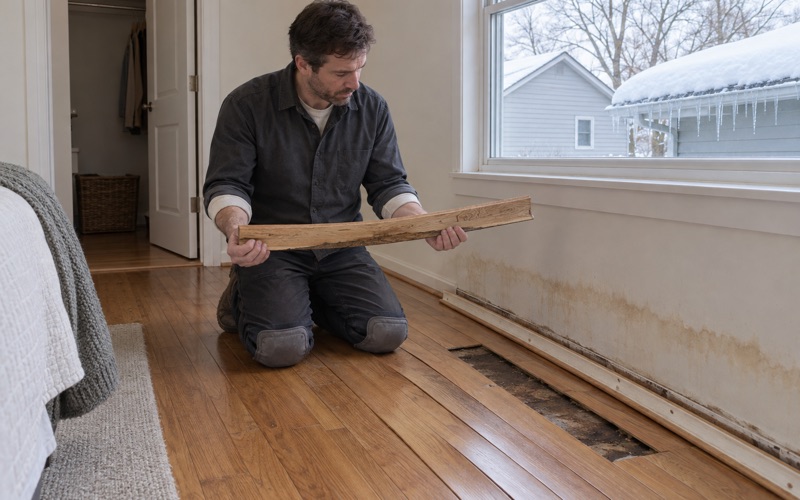
Where water has come through, from a supply line, an ice dam or a slow leak under an appliance, we photograph and document the floor for the claim before anything is torn out. Once a damaged floor is in a dumpster, the evidence of what like kind and quality actually meant goes with it.
Upstairs units and attached buildings
Attached structures of two or more units hold 12.4 percent of the city’s housing units, and hard flooring in those buildings carries sound requirements. Association rules commonly reference impact insulation class 45 and sound transmission class 45, and an underlayment assembly either meets what the board asks for or the job stops on day two.
We settle that paperwork before the first day rather than during it. Getting an association or a property manager to approve an assembly in writing is far less painful than getting a half-finished job restarted after somebody complains.
Code, and something to check the work against
The Minnesota State Building Code applies here as administered by the City of Waconia Building Official, and floor covering work of this kind ordinarily sits inside the finish-work permit exemption at Minnesota Rules 1300.0120. Structural trouble under a floor is a different conversation, and we raise it when we find it rather than covering it with new wood.
The same crew runs a job from the estimate through the final coat, and the quote goes out with a written grit sequence and finish schedule attached. An owner or a property manager should be able to check the finished floor against something specific rather than judging it by how it looks in the light.
- 20+ Years Experience
- Free Written Estimates
- Dust Containment on Every Sand