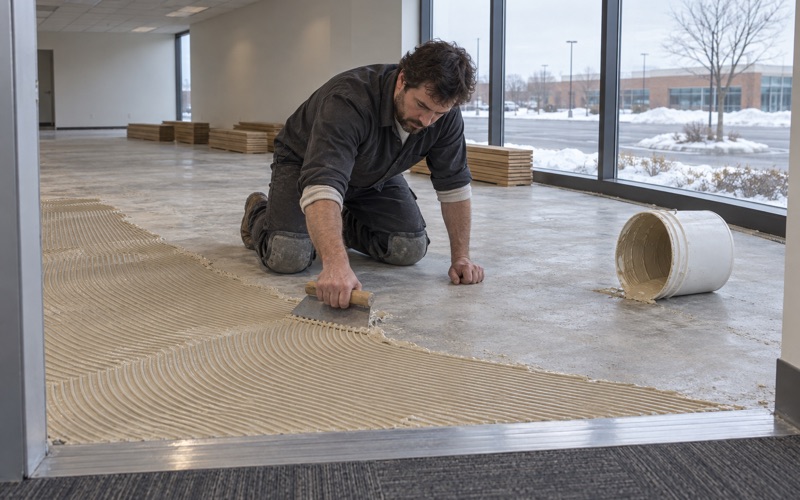
Burnsville Wood Flooring has spent more than twenty years installing, sanding and refinishing wood flooring in Whittier and across the rest of the metro. The work we are called for here is rarely a bare-shell install and almost never a blank sheet. It is usually an existing floor that has to be brought back to a defensible condition, on a schedule that other people are already living around.
That changes what an estimate has to contain. We read indoor relative humidity with a hygrometer on the first visit and write the number down, because wood flooring is specified for a band that most heated Minnesota buildings drop out of by January. We check the moisture content of the flooring against the moisture content of the subfloor before a single board goes down, not after the first cupped row appears.
A written grit sequence and finish schedule goes out with the quote, so the finished job can be measured against something instead of argued about afterward. The crew that walks the floor at the estimate is the crew that rolls the final coat.
Pre-war houses under a thick postwar apartment layer
Across census tracts 1069 and 1070 in Hennepin County, 1,813 of 3,967 housing units, 45.7 percent, were built in 1939 or earlier, and 3,175 units, 80.0 percent, were built before 1980. Those two tracts contain 2400 3rd Avenue South and 2600 Blaisdell Avenue South and approximate the Whittier boundary of Franklin Avenue, Interstate 35W, Lake Street and Lyndale Avenue. They are not a City-published neighborhood geography, and we do not quote them as one.
The same two tracts describe what those buildings are. One-unit detached structures hold 192 of the 3,967 units, 4.8 percent, and two-unit structures hold 340 units, 8.6 percent, while buildings of ten or more units hold 2,485 units, 62.6 percent. A wood floor question in this part of Minneapolis is far more often a question about one unit inside a larger building than about a whole house.
What the 1939-or-earlier cohort has underfoot
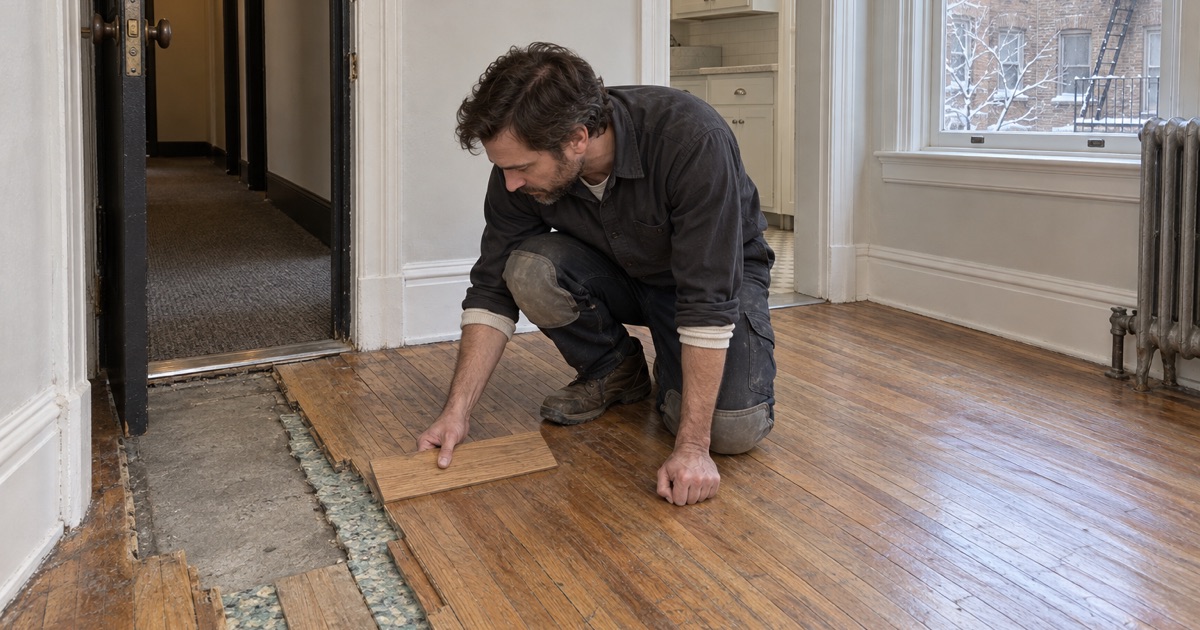
What we find in the oldest of these buildings is usually narrow strip red oak, sometimes quartersawn white oak in the front rooms, laid tongue-and-groove over a board subfloor. Wood that old often carries lathe checks and decades of overwood at the joints, which is a sanding problem before it is a finish problem. We measure what is left above the tongue at a heat register or a closet threshold, because that thickness decides whether the floor can take a full sand at all.
Species matters less here than what has already been taken off. Red oak and hard maple both turn up in this stock, hickory and American walnut far less often, and Janka hardness describes how a floor will wear from here rather than how much sanding it can still survive. Stair treads, nosings and risers are a separate scope in our quotes, because they almost never match the field in either wear or finish.
The apartment layer built up around them
The 1950s and 1960s buildings that fill in between the older houses behave differently under a drum sander, and what sits beneath the finish flooring varies enough by era that we open a vent boot or a closet corner to find out rather than assume. Plywood and OSB subfloors, thinner assemblies and long shared corridors change how a job is staged and how the floor sounds afterward. Where a building’s own rules set an ASTM E492 impact insulation class or ASTM E90 sound transmission class figure for what goes under wood, we want those rules before the quote rather than after it.
Looking for wood-flooring closer to St. Louis Park? See Wood-Flooring Services in St. Louis Park.
Floor condition is a licensing question, not only an owner’s
Across the same two tracts, 526 of 3,607 occupied housing units are owner-occupied, 14.6 percent, and 3,081 units, 85.4 percent, are renter-occupied. That ratio is why floor condition here is usually a compliance question at the same time it is a decorating one, and why the person paying for the work is often not the person standing on it.
What chapter 244 asks of a floor
All rental dwellings in Minneapolis must be licensed by the City, and the maintenance standard in chapter 244 of the Code of Ordinances requires interior floors to be kept in a professional state of repair, structurally sound, without holes and without trip hazards. That is a condition standard rather than an appearance standard. A dull, worn finish and a raised board edge at a doorway are not the same problem, and we price and sequence them differently.
We walk a unit with that distinction in mind and separate what has to be repaired from what someone would simply prefer to replace. A written scope that says which is which is easier to hand to a property manager, a partner or an inspector than a single number at the bottom of a page.
Trip hazards earn their own line in a scope for a reason. A lifted board end or a failed threshold is a same-week repair, while a tired finish can usually wait for a turn between tenancies, and sorting a floor into those two buckets on the first visit is often what makes a building’s flooring budget work across a year instead of in one expensive month.
At a sale, the floor is an item on the report
Minneapolis Truth in Sale of Housing applies to single-family houses, duplexes, townhouses and first-time condominium conversions. An evaluation by a Minneapolis-licensed evaluator is required within three days of offering the property for sale and before showing, and the report stands for two years or one sale. Floor condition is one of the items the evaluator covers.
Lead-based paint is not something the evaluator looks at, so nothing in that report should be read as saying anything about paint. Knowing which document covers what keeps a flooring scope from being written against the wrong one.
Scheduling work in a building that stays occupied
The pre-1978 rule shapes the sequence
Minnesota is not on the EPA list of authorized Renovation, Repair and Painting states, so EPA administers the RRP program here, and federal firm and renovator certification governs renovation that disturbs paint in pre-1978 housing. In a building from this era that rule belongs in the schedule and the containment plan before it belongs anywhere else, so we settle how it applies to the specific scope well before a sander comes through the door.
Dust, noise and the difference between dry and cured
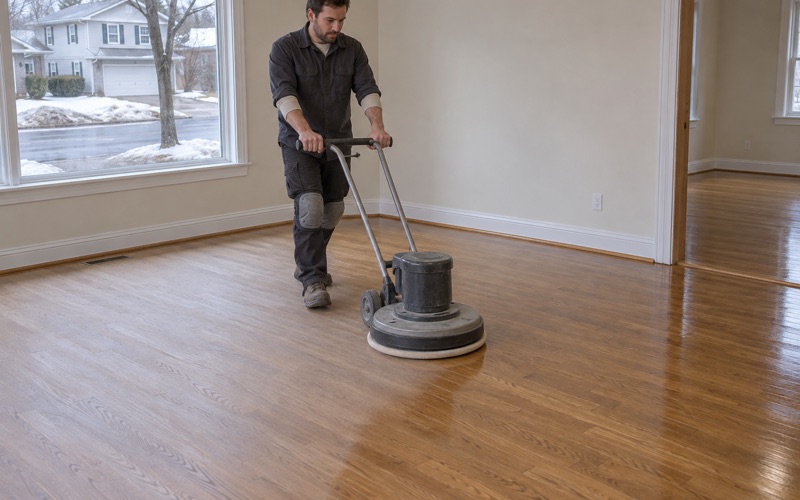
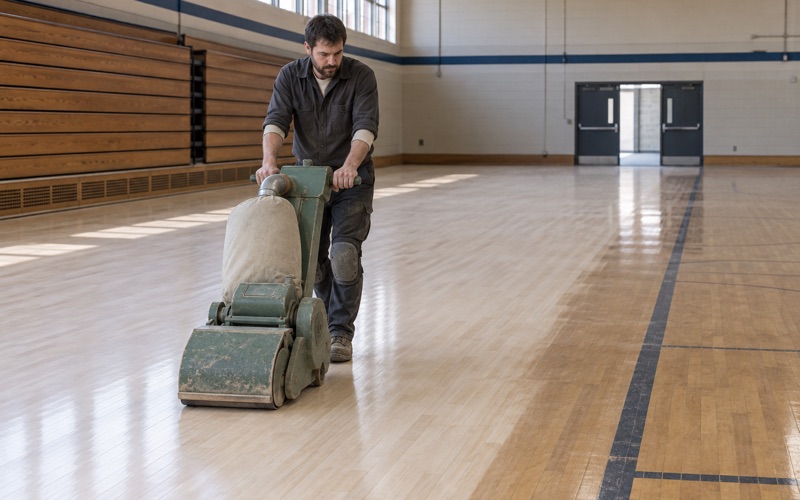
Every sanding job carries dust containment, and we will give you a straight answer about what containment does not catch. Drum sander, edger and buffer work is loud and it travels through an old building, so the hours the building actually keeps belong in the plan rather than in an apology afterward.
Cure time and dry time are different numbers. With waterborne polyurethane the gap between them decides when furniture, rugs and ordinary traffic can come back, not merely when the floor stops feeling tacky underfoot, and residents who are still living there deserve both dates in writing.
Finish choice follows the building as much as it follows the floor. Waterborne polyurethane returns a unit to service sooner and carries less odor into a corridor other people use, oil-modified polyurethane ambers and takes longer to get there, and hardwax oil asks for a maintenance habit somebody in the building has to actually keep. We name the one we would choose for the unit in front of us, with the sheen level, in the same document as the grit sequence.
Approvals settled before the first day
Association and board paperwork is sorted out before an upstairs job starts, so the work is not stopped halfway through by a form nobody asked for. Minnesota Rules 1300.0120 subpart 4 item A exempts finish work such as painting, papering, tiling, carpeting, cabinets and countertops from the permit requirement, and the same subpart states that an exemption does not authorize work that violates the code or another law or ordinance.
Whittier also holds the Washburn-Fair Oaks Historic District, locally designated in 1976 and generally bounded by Franklin Avenue East, 4th Avenue South, Interstate 35W, 26th Street East and the alley between 1st Avenue South and Nicollet Avenue South. That local designation applies to exterior features, so an interior floor sits outside its scope even inside those boundaries.
Old floors that have already outlived several tenancies
A floor in a building that has turned over residents for eighty years has usually been coated more than once, and the honest question is how much wood is left to work with. On engineered flooring we measure the wear layer before quoting a refinish, because past a certain thickness there is nothing left to sand and the result is a sand-through. On solid strip we read the same limit from the fastener line instead.
Recoat, refinish, or replace the boards that failed
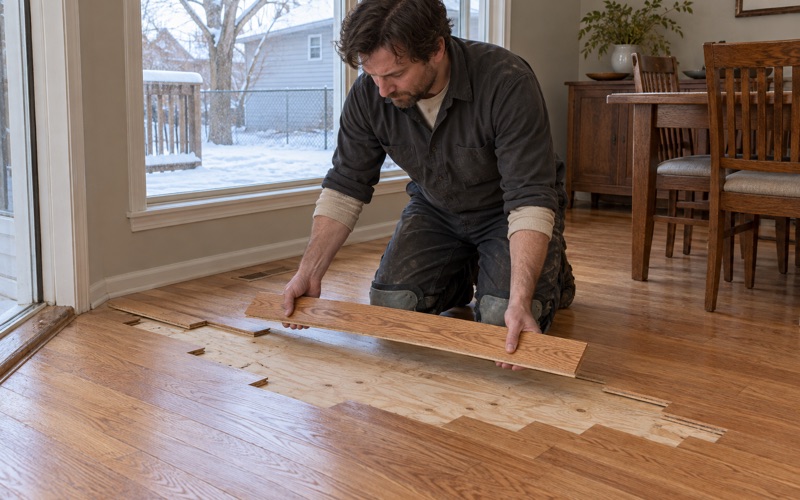
A screen-and-recoat with an abrasive screen buys years on a floor whose finish is worn but whose wood is sound, and we quote it honestly against a full 36-50-80 grit sequence, including the times the cheaper option is the right one. Where individual boards are past saving, a board replacement, a weave-in or a dutchman patch keeps the rest of the floor intact.
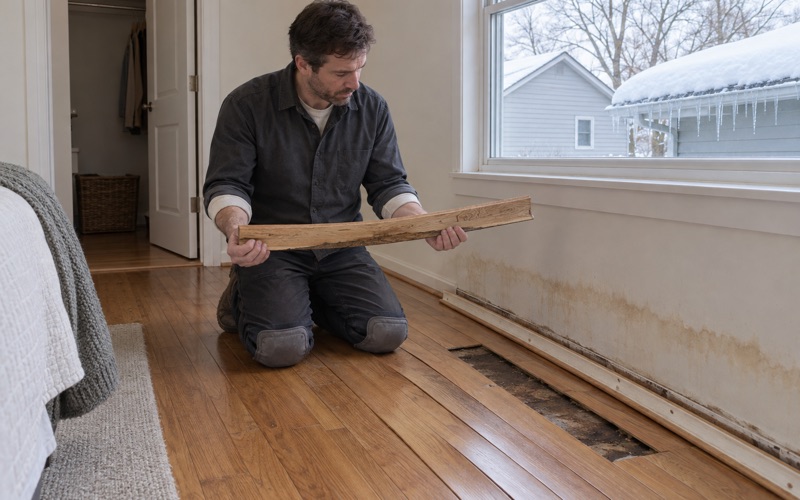
Water-damaged floors are photographed and documented for the claim before anything is torn out. A burst supply line in a hundred-year-old building rarely stops at one room, and the record of what the floor looked like beforehand is worth more than any argument made afterward.
An expansion gap hidden under base and shoe is what lets an old floor take on a humid July without buckling, and it is one of the first things we look for on a floor somebody else has already sanded. Where a subfloor has moved far enough that new material would telegraph every dip, self-leveling underlayment or board-by-board correction goes into the quote as its own line rather than arriving as a surprise on the second day.
Winter gapping is not automatically a defect
Seasonal gapping appears every January in buildings heated hard and humidified lightly, and a good share of it closes again by June. We measure it and explain it before anyone calls it a defect, and we keep it separate from cupping, crowning and dry cupping, which have different causes and different remedies. Holding indoor relative humidity in the thirty to fifty percent band is what keeps a floor near its equilibrium moisture content through a Minneapolis winter.
Sequencing around the heating season
We plan work around the heating season rather than in spite of it, because acclimation and a moisture content differential read in a building running forced air in February mean something different from the same readings taken with the windows open in September. A floor put down to NWFA installation guidelines in the wrong week can be technically correct and still move for a year.
The blocks along Nicollet Avenue keep long hours, and the restaurants, coffee shops and Asian markets that line the corridor, together with the Minneapolis Institute of Art and the Children’s Theatre Company, make parking, deliveries and quiet hours something to plan rather than assume. We would rather build that into the schedule than discover it on the first morning of a sanding job.
- 20+ Years Experience
- Free Written Estimates
- Dust Containment on Every Sand